Quality Assurance vs Quality Control: The Procurement Mistakes That Cause Production Issues
Most procurement teams use quality assurance and quality control interchangeably. They are not the same thing, and the confusion between them is one of the most reliably expensive mistakes in global sourcing.
When the wrong framework is applied at the wrong moment in the production cycle, the results are predictable: goods that leave a factory looking right and arrive wrong, shipments failed at destination inspection, reorder costs, margin erosion, and supplier disputes that could have been avoided entirely. The problem is rarely a shortage of quality intent. It is almost always a structural misunderstanding of where quality assurance ends and quality control begins.
This article explains the distinction clearly, walks through the procurement mistakes that follow from confusing the two, and sets out what a properly integrated quality control and quality assurance programme looks like in practice. It is written for procurement directors, sourcing managers, and operations leads who want their supply chain to produce consistent, on-spec product rather than a cycle of inspections, rejections, and rework.
What Is Quality Assurance?
Quality assurance is a process-oriented discipline. It is concerned with preventing defects by designing and managing the systems, standards, and conditions under which production takes place. The goal of quality assurance is to get the process right so that the output is right, consistently, without relying on end-of-line inspection to catch what went wrong.
In practical sourcing terms, quality assurance covers the work that happens before and during production: the specification and approval of materials, the qualification of suppliers, the definition of production standards, the training and capability of factory staff, and the monitoring of processes in real time. When quality assurance is functioning properly, the conditions for defect-free production are in place before a single unit rolls off the line. The American Society for Quality (ASQ) defines quality assurance as part of quality management focused on providing confidence that quality requirements will be fulfilled. That word, confidence, is important. Quality assurance is about building the structural conditions for good outcomes, not reacting to bad ones.
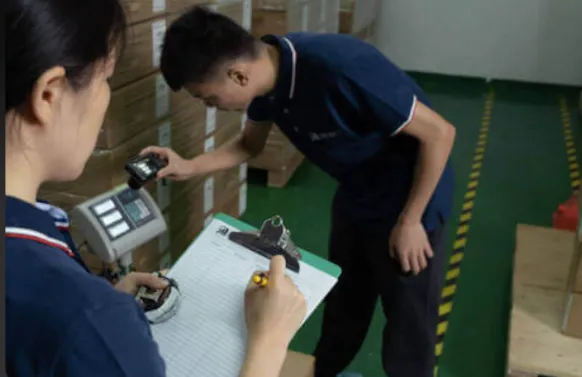
Quality Assurance in the Context of Global Sourcing
In a global sourcing context, quality assurance operates across the entire supplier relationship. It begins at supplier qualification: assessing whether a factory has the process capability, the management systems, and the technical competence to produce your product to specification before any order is placed. It continues through pre-production approvals, golden sample sign-off, material verification, and factory process audits. It is ongoing and systemic, not episodic. The ISO 9001 Quality Management System standard is the internationally recognised framework for quality assurance governance. Suppliers holding ISO 9001 certification have demonstrated that they operate documented, auditable quality management systems. It is a meaningful credential, though, as with any certification, it reflects a point-in-time assessment of systems rather than a guarantee of ongoing product quality.
Quality Assurance Testing: What It Actually Means on the Ground
Quality assurance testing is often misunderstood as a synonym for product inspection. It is not. Quality assurance testing refers to the verification of processes, systems, and inputs rather than finished outputs. It includes testing the tensile strength of raw fabric before it enters production, verifying that a factory’s measuring equipment is correctly calibrated, or conducting trial runs to confirm that a new production process produces consistent output before full-scale manufacturing begins.
In practice, rigorous quality assurance testing at the pre-production stage prevents the vast majority of defects that would otherwise only become visible at end-of-line product inspection or, worse, at the customer’s receiving dock. The cost of identifying and correcting a problem at the quality assurance testing stage is a fraction of the cost of correcting it after production has completed. The Chartered Institute of Procurement and Supply (CIPS) consistently highlights pre-production quality frameworks as a primary driver of procurement performance, noting that businesses with structured quality assurance programmes experience significantly lower rates of production failure and supplier disputes.
What Is Quality Control?
Quality control is a product-oriented discipline. Where quality assurance focuses on the process, quality control focuses on the output. It is the set of activities used to verify that a finished or partially finished product meets the specified standard. Quality control is reactive by nature: it measures what has been produced and identifies whether it conforms to specification. This is not a criticism. Quality control is an essential part of any production programme, and when it is designed and applied well, it provides the critical final verification that goods leaving a factory are fit for purpose. The problem arises when businesses treat quality control as the entirety of their quality programme rather than as one layer within a broader quality control and quality assurance framework.
Product Inspection as Quality Control in Action
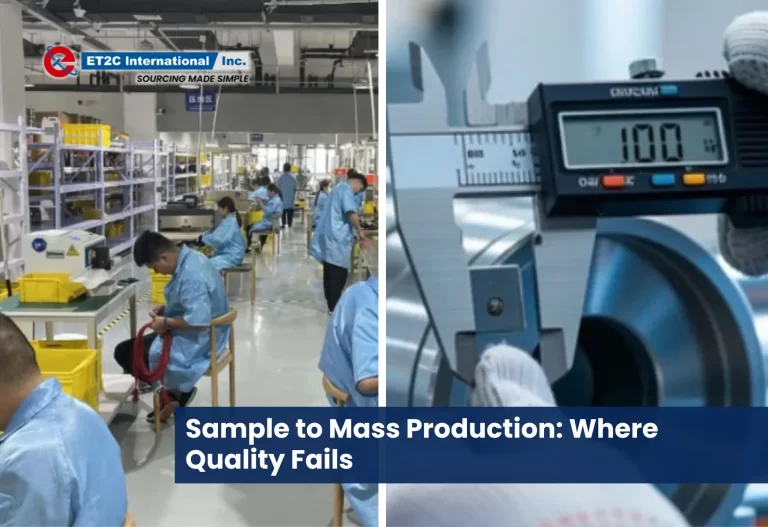
Product inspection is the most common form of quality control in global sourcing. A product inspection involves a trained inspector visiting the factory at a defined point in the production cycle, drawing a statistically representative sample of units from the production run, and assessing them against a defined set of criteria: dimensions, function, appearance, labelling, packaging, and any product-specific requirements.
The standard framework for product inspection sampling is AQL, or Acceptable Quality Level, which defines the maximum number of defective units in a sample that still allows the batch to pass. The ASQ’s guidance on acceptance sampling provides the technical framework most commonly used in international trade. AQL inspections can be conducted at three stages: during production (DUPRO), when production is 100 percent complete and ready to pack (pre-shipment), or at the port of loading.
ET2C International’s product inspection services cover all three stages across China, India, Vietnam, and Turkey, with in-market inspectors able to visit factories within 24 to 48 hours of booking. The combination of speed and local presence is what makes product inspection genuinely useful rather than a bureaucratic step: when a quality control issue is identified, there is time to address it before the shipment is sealed.
Defects Meaning: What Procurement Teams Are Actually Managing
Understanding defects meaning in a production context is more nuanced than it might appear. In quality control and product inspection frameworks, defects are classified into three categories, and the commercial and reputational implications of each are very different. A critical defect is one that renders a product unsafe or completely non-functional. In regulatory terms, a critical defect may constitute a product liability exposure and can result in recalls, enforcement action, or bans. The defects meaning in this category is unambiguous: the product cannot be sold or used. A major defect is one that makes a product unlikely to be fit for its intended purpose or that a customer would consider a reason for rejection or complaint. Major defects significantly affect the saleable quality of the goods even if they do not constitute a safety risk.
In most AQL frameworks, a batch with more than a defined proportion of major defects will fail product inspection. A minor defect is a departure from specification that is unlikely to materially affect the product’s function or the customer’s satisfaction. Minor defects are tracked in quality control reporting as an indicator of process consistency, even when they do not by themselves cause a batch to fail. Understanding defects meaning at each classification level is the foundation of a rational quality control programme: it allows procurement teams to prioritise remediation effort and to make clear, defensible decisions about what is and is not acceptable.
The International Organisation for Standardisation provides the reference framework for defect classification within ISO 9001-aligned quality control systems. For product-specific requirements, regulators such as the UK’s Office for Product Safety and Standards (OPSS) and the EU’s General Product Safety Regulation (GPSR) set the mandatory standards that define critical non-conformance in their respective markets.
Quality Assurance vs Quality Control: The Key Differences Procurement Teams Must Know
The distinction between quality assurance vs quality control is not merely academic. It maps directly onto where in the production process you intervene, what you are trying to achieve, and what the consequences of getting it wrong look like. Most costly production failures share a common root: the procurement team applied quality control thinking where quality assurance was needed, or assumed that quality assurance was in place when it was not.
Process vs Output: The Fundamental Distinction
Quality assurance governs the process. Quality control governs the output. This is the central distinction in any quality assurance vs quality control analysis, and it is the distinction that determines when each should be active in the production timeline. A business that invests heavily in end-of-line product inspection and skimps on pre-production quality assurance will consistently find defects too late to address them without cost. A business that invests in quality assurance but conducts no product inspection is relying on the assumption that its process controls are working without ever verifying the output. Neither position is rational. The two disciplines are complementary, and the quality control and quality assurance framework only functions when both are operating together.
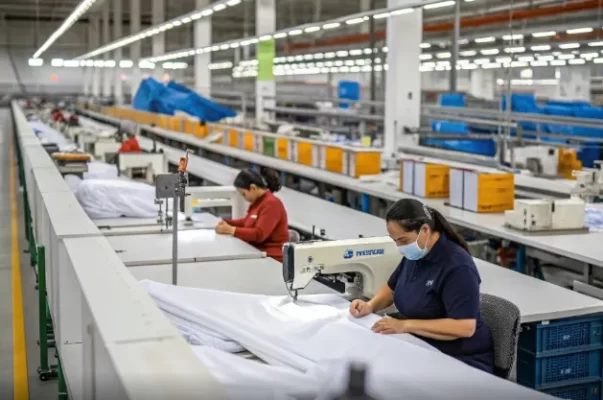
The $1-10-100 Rule: Why Where You Intervene Determines What You Pay
Before defining the terms, it is worth establishing the financial logic that makes the quality assurance vs quality control distinction commercially important. The $1-10-100 rule states that a quality problem costs $1 to prevent at the design and process stage, $10 to correct when detected during production, and $100 to resolve once it has reached the customer.
First articulated by quality economists G. Labovitz and Y. Chang, the rule has been validated consistently across manufacturing sectors. The ASQ Cost of Quality framework formalises it into four cost categories: prevention, appraisal, internal failure, and external failure. Every dollar not invested in prevention tends to compound into multiples at each subsequent stage. A product inspection failure costs ten times as much to manage as a pre-production quality assurance check would have cost to prevent it. A product quality failure reaching the end customer costs one hundred times as much again.
The ROI Case: 8.4% vs 0.6%
The return on quality investment is not theoretical. Research referenced in the Forbes and ASQ Quality Progress report found that companies with mature quality assurance programmes achieved revenue growth rates of 8.4% compared to 0.6% for businesses with weak or reactive quality systems. The differential reflects what the $1-10-100 rule predicts: prevention is not a cost centre. It is a margin protector. For procurement teams managing global sourcing programmes, this has a direct implication. The cost of a thorough pre-production quality assurance programme is predictable and manageable. The cost of a production failure caught at pre-shipment product inspection, or worse, at the customer’s door, is neither. The $1-10-100 rule is not a theoretical principle. It is the financial logic that separates procurement teams that control quality from those that react to it.
Timeline: When Each Discipline Is Active
Quality assurance is active before and during production. It covers supplier qualification, material approval, pre-production samples, process audits, inline checks, and quality assurance testing of inputs and outputs at each production stage. Quality control is active at defined inspection points during and after production: during-production inspection, pre-shipment product inspection, and final loading checks. A properly structured quality control and quality assurance programme treats these as sequential and overlapping stages of a single quality framework, not as alternative options. Understanding this timeline is the foundation of sound procurement quality management. The CIPS Quality Management guidance sets out this integrated approach as best practice for procurement professionals operating across international supply chains.
The Procurement Mistakes That Blur the Line Between QA and QC
Most production quality failures are not supplier failures. They are procurement failures: structural mistakes in how quality assurance vs quality control is designed and resourced across the supply relationship. Here are the three most common, and what each one costs.
Mistake 1: Treating Pre-Shipment Inspection as the Entire Quality Programme
This is the most widespread mistake in global sourcing. A business books a pre-shipment product inspection with a third-party inspection company, receives a pass or fail result, and treats this as adequate quality control and quality assurance coverage. It is not. Pre-shipment product inspection catches defects that already exist. It does nothing to prevent them. When a pre-shipment inspection fails, the procurement team faces a binary and expensive choice: rework at cost and time, or accept the goods at a negotiated discount and manage the downstream commercial consequences. Either outcome was avoidable with a proper quality assurance programme that caught the process deviation earlier in production.
Third-party inspection providers including Bureau Veritas and SGS offer pre-shipment product inspection as a commodity service. These are useful and important services. But they are quality control tools, not quality assurance programmes, and procurement teams that treat them as the latter will consistently experience the same production failures on repeat.
Mistake 2: Treating Supplier Certification as Quality Assurance
A supplier with ISO 9001 certification, a BSCI audit pass, or an approved factory status on a retailer’s approved vendor list is not automatically a supplier with effective quality assurance in place for your product. Certifications confirm that a factory operates quality management systems to a defined standard at the point of assessment. They say nothing about whether those systems are designed around your specific product requirements, your tolerance specifications, your material standards, or your packaging requirements. The amfori BSCI framework and ISO 9001 are both credible and meaningful assessments of a factory’s general quality management capability. Neither is a substitute for product-specific quality assurance testing and pre-production qualification conducted against your own specifications.
Mistake 3: Skipping Pre-Production Alignment
This mistake is particularly common when a business is reordering from an existing supplier. The assumption is that because the previous order was produced correctly, the next one will be too. In reality, supplier processes are not static. Raw material sources change, production staff turn over, factory capacity shifts, and subcontractors appear without notification. Without pre-production quality assurance sign-off on materials, components, and process confirmation for each order, these changes go undetected until product inspection finds the result. Pre-production quality assurance alignment, including golden sample approval, material certification checks, and process capability confirmation, is not bureaucracy. It is the mechanism by which a procurement team maintains control over what is actually being produced on its behalf. Without it, the defect’s meaning conversation happens too late to matter.
What a Properly Structured Quality Programme Looks Like in Practice
The goal of a well-designed quality control and quality assurance framework is not to catch problems. It is to create the conditions under which problems do not occur, and to verify that those conditions are holding at each stage of production. Here is what that looks like across the three critical phases.
Pre-Production: Where Quality Assurance Does Its Most Important Work
Before production begins, quality assurance activity should cover three things. First, supplier qualification: confirming that the factory has the process capability, equipment, and technical competence to produce your product to specification, using your approved materials. This is where quality assurance testing of raw materials and components takes place, and where process trials confirm production capability before full orders are placed.
Second, specification alignment: ensuring that production staff have access to clear, unambiguous product specifications, approved golden samples, and documented tolerance limits for every attribute that matters. Specification ambiguity at the pre-production stage is one of the most common causes of quality control failures later in the cycle. A defect that arises because a factory interpreted a vague specification differently to the buyer is a quality assurance failure, not a quality control one.
Third, pre-production sample approval: a physical sign-off on samples produced using the actual production materials, the actual factory processes, and the actual workforce that will execute the order. Pre-production samples are the final quality assurance testing gate before production commitment, and skipping them, which many procurement teams do to save time, routinely results in production runs that deviate from the approved specification in ways that only become visible at product inspection.
During Production: Inline Inspections and Real-Time Monitoring
During-production quality control activity, commonly referred to as DUPRO (during production inspection), provides a checkpoint when approximately 20 to 30 percent of the order has been produced. At this stage, a sample of completed units is assessed against the approved specification, and the production line processes are reviewed for conformance.
The commercial value of a DUPRO product inspection is significant. If a deviation is found when 25 percent of production is complete, the remaining 75 percent can be corrected. If the same deviation is only identified at pre-shipment stage, when 100 percent of the order has been produced, the options are remediation, discount negotiation, or rejection. The cost differential is material. ET2C International’s in-market teams conduct quality control inspections at all production stages, with reporting provided within 24 hours of the inspection visit.
Pre-Shipment: Product Inspection as the Final Gate
Pre-shipment product inspection is the final verification that goods conform to specification before they leave the factory. Conducted when 100 percent of production is complete and at least 80 percent of goods are packed, it provides a statistically valid sample assessment of the full production run using AQL methodology. An effective pre-shipment product inspection covers quantity verification, appearance and workmanship, functional testing, measurement checks, carton marking and labelling, and where relevant, packaging drop and compression testing. The results determine whether the shipment proceeds, whether rework is required, or whether the goods are rejected. Understanding defects meaning across critical, major, and minor classifications is what makes the pass or fail determination defensible rather than arbitrary.
For markets with specific regulatory requirements, pre-shipment quality control should also verify that all mandatory conformity documentation, certification marks, and regulatory labels are correct and in place before the goods leave the factory. This is particularly important for the EU and UK markets, where the EU General Product Safety Regulation and OPSS product safety framework impose obligations that sit squarely
How ET2C International’s In-Market Quality Teams Protect Your Production
The structural problem with most quality assurance vs quality control programmes is that they are managed remotely. A specification document is sent to a supplier, a third-party product inspection is booked when production is complete, and everything in between, the process, the materials, the day-to-day production decisions, happens out of sight. ET2C International’s model is built around closing that gap. With in-market teams across China, India, Vietnam, and Turkey, ET2C’s quality and compliance services provide quality assurance and quality control oversight at every stage of the production cycle, not just at the point of shipment.
At the pre-production stage, our teams conduct factory technical assessments, review and align product specifications with production teams in the local language, verify material approvals, and sign off on pre-production samples against golden standards. This quality assurance testing stage is where the majority of downstream quality control problems are prevented, and it is the stage that most remote procurement programmes skip. During production, our in-market inspectors conduct DUPRO product inspection visits that identify process deviations while there is still time to correct them.
At the pre-shipment stage, we conduct full AQL product inspection covering workmanship, function, measurement, labelling, and packaging. Reports are issued within 24 hours, with clear findings against the defects, meaning classifications agreed at the start of the programme. For businesses that want to build a genuinely integrated quality control and quality assurance framework rather than a reactive inspection programme, ET2C provides the in-market infrastructure to make it operational rather than aspirational. Explore our quality assurance and product inspection services or speak to our team about how we can support your specific sourcing markets.
Quality Considerations Across Key Sourcing Markets
The quality assurance vs quality control challenge is not identical across all markets. Production culture, subcontracting norms, factory management maturity, and the relationship between price and quality risk vary significantly between sourcing territories. A quality control and quality assurance programme designed for Turkey may need meaningful adjustment for Vietnam. Here is what ET2C’s in-market teams observe across the four primary sourcing markets.
China: Capability and Complexity
China’s manufacturing base is extraordinarily diverse in capability. At one end, world-class, ISO-certified factories with sophisticated in-house quality assurance systems and proprietary quality assurance testing laboratories. At the other, informal workshops with limited process documentation and variable management of defects meaning and rework standards. The procurement challenge in China is not finding capable suppliers: it is verifying that the factory producing your order is the one you qualified, and that its quality control systems are in use every day, not just on audit day. Subcontracting without disclosure is a specific quality assurance risk in China.
A factory that passes qualification and produces excellent samples may route part of a production run to a subcontractor whose quality control standards are significantly lower. In-market product inspection activity by ET2C’s China teams regularly identifies production runs that have been partially or fully subcontracted to facilities that were never part of the quality assurance qualification programme. The Better Work China programme and the China National Accreditation Service (CNAS) both publish factory-level data that can inform quality assurance risk assessments.
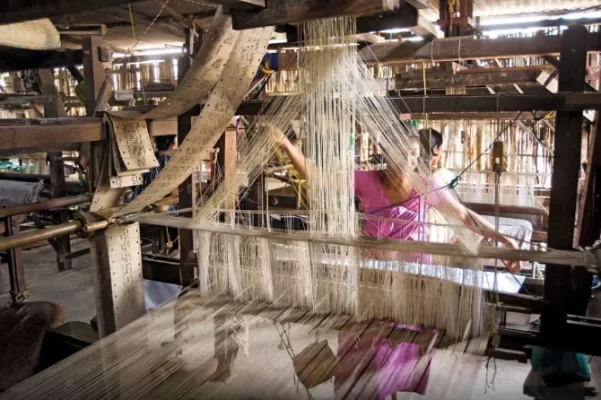
India: Artisan Skill and Process Consistency
India’s manufacturing strength lies in skilled, artisan-led production, particularly in textiles, home furnishings, and crafted goods. The quality of handwork from India’s best factories is exceptional, and many have invested significantly in quality control and quality assurance infrastructure to support export markets. The quality assurance vs quality control challenge in India is often one of process consistency: high-skill production can be highly variable, and the quality assurance testing required to manage that variability requires close, in-market oversight rather than periodic product inspection. Sub-tier production, particularly for embellished and finished goods, is common in India and introduces quality control risk at points in the supply chain that are rarely visible to a buyer operating remotely.
ET2C’s India teams provide quality assurance oversight that extends beyond the tier-one factory into the sub-contracted finishing processes, where defects, meaning most commonly, become a commercial problem. The Quality Council of India (QCI) provides the national framework for quality assurance standards across Indian manufacturing sectors.
Vietnam: Speed, Growth, and Inline Quality
Vietnam’s manufacturing sector is growing rapidly, and so is the sophistication of its quality control and quality assurance infrastructure. Many factories, particularly in the garment, footwear, and furniture sectors, now operate structured quality assurance programmes aligned to international standards, driven by the requirements of their major brand and retailer customers. The quality assurance vs quality control challenge in Vietnam is primarily one of workforce turnover and production speed. High growth rates in the manufacturing sector mean that experienced production workers and quality managers are in demand, and turnover rates are significant.
Quality assurance testing and inline quality control systems that depend heavily on individual operator experience rather than documented process standards are therefore more variable than they appear. The ILO Better Work Vietnam programme provides useful factory-level performance data for the garment sector. ET2C’s Vietnam team combines product inspection coverage with pre-production quality assurance support that addresses process documentation gaps specific to this market.
Turkey: Proximity, Standards, and Seasonal Pressure
Turkey’s quality control and quality assurance capability is generally strong, particularly in textiles, leather, and ceramics, where many factories operate to European technical standards and hold relevant certifications. For European buyers, Turkey’s proximity means that in-person quality assurance engagement is more accessible than in Asia, and mid-production corrections are easier to implement without disrupting the delivery schedule. The quality assurance vs quality control risk in Turkey is most pronounced at peak production periods, when factories operating at full capacity under seasonal pressure may take shortcuts in quality control processes that are not reflected in their normal operating standards. Regular product inspection coverage during these periods, rather than relying on the factory’s own quality assurance systems, is the most effective mitigation. The Turkish Standards Institution (TSE) maintains the national framework for quality assurance and quality control standards across Turkish industry.
From Reactive to Resilient: Building Quality Into Your Supply Chain
The businesses that manage quality assurance vs quality control well share one characteristic: they treat quality as a sourcing discipline, not an inspection event. They have clear quality assurance requirements built into every supplier relationship from qualification onwards.
They conduct quality assurance testing at pre-production stage as a matter of course. They use product inspection at multiple points in the production cycle, not just at the gate before shipment. And when quality control findings reveal a process deviation, they address the root cause rather than accepting a rework and moving on. This approach costs more to resource than a single pre-shipment product inspection. It costs significantly less than the alternative: repeat production failures, supplier disputes, reorder programmes, chargebacks, margin erosion, and the reputational damage of product quality failures reaching the end customer. The $1-10-100 rule applies here with full force: the dollar spent on quality assurance at the front end is always cheaper than the hundred dollars spent managing a failure at the customer’s door.
The CDP Supply Chain Report consistently demonstrates that businesses with mature supply chain governance frameworks, including integrated quality control and quality assurance programmes, outperform peers on both operational resilience and long-term profitability. The cost of quality is not the cost of quality assurance and quality control activity. It is the cost of the failures that activity prevents. If you want to understand where your current quality assurance vs quality control programme is genuinely strong and where it is exposed, ET2C’s Sourcing Stress Test scores your sourcing operation across five dimensions, with quality and compliance as one of the five pillars assessed.
Frequently Asked Questions

Anishi Gupta
Position: Digital Marketing Specialist
Anishi Gupta is a Digital Marketing Specialist focused on performance marketing, content strategy, and data-driven growth at ET2C LinkedIn or anishi.g@et2c.com.