
El Niño 2026: What It Means for Your Global Sourcing Strategy | ET2C International
A powerful El Niño is forming with 98% probability. As if the current raft of challenges to global sourcing strategies were not enough El Nino could bring another round of challenges to be overcome by sourcing and procurement teams across the globe. Demonstrating the need for sourcing risk and vulnerabilities to be constantly checked and mitigated.
Discover how it will disrupt global sourcing strategies and supplier sourcing across Asia, and what your strategic sourcing process must do now.
“It was the best of times, it was the worst of times… the season of Light, the season of Darkness, the spring of hope, the winter of despair.” Dickens wrote those words to describe the upheaval of revolution, but they could just as easily describe what happens to global supply chains every time a major El Niño event takes hold. The climate phenomenon that Peruvian fishermen named after the Christ Child arriving, as it did, around Christmas has a habit of arriving with all the disruption of revolution and none of the warning.
In 2026, it is arriving again and by multiple accounts, it could be one of the most powerful on record. For businesses that depend on international supplier sourcing across Asia, Latin America, and beyond, the time to act is now before the warm water reaches the shore

The Science of the Coming El Nino Storm
The forecasts are converging with unusual confidence. The World Meteorological Association (WMO) now puts an 80% likelihood of an El Niño event during June & August 2026, with probabilities of it continuing through at least November running at or above 90%. Most forecast models suggest the event will be at least moderate and possibly strong.
The International Research Institute for Climate and Society (IRI) at columbia university is even more direct. Its May 2026 ENSO plume forecast assigns a 98% probability of El Niño conditions for May to July 2026, with that figure remaining at 97–98% throughout the forecast period extending into early 2027. La Niña development is, in IRI’s assessment, effectively a zero probability.
NOAA’s Climate Prediction Center, meanwhile, has warned of a 2-in-3 chance of a strong or very strong El Niño for the November–January 2026–27 season. Climate scientist Daniel Swain, reviewing the latest model data, offered a blunter verdict: “All signs are increasingly pointing to a significant, if not strong to very strong, El Niño.”
The so-called spring predictability barrier means some uncertainty in peak intensity remains. But the direction of travel is not in doubt. El Niño is coming, and for businesses whose global sourcing strategies span Vietnam, India, China, and other climate-exposed markets, the implications are significant.
What impact the last event taught us about strategic sourcing
To understand what is at stake, it helps to look back at the 2023–24 El Niño, itself a significant event that demonstrated just how comprehensively a warming Pacific can re ach into the arteries of global trade.
The impact on agricultural commodities was stark. Soft commodity prices, coffee, cocoa, sugar, corn, soybeans rose 12.3% from the prior year, according to the Dow Jones–UBS index. This contributed to persistently elevated food inflation globally and slowed central banks’ moves to lower interest rates. Brazil’s primary sector was particularly badly hit by extreme weather. In Asia, 2023’s monsoon was the driest in five years in India, dampening output of key crops including rice and triggering export restrictions that rippled through global markets. The Ivory Coast saw cocoa deliveries to its ports fall by more than 35% year-on-year in the October–January period.
Sugar production in India and Thailand, two of the top five global producers, fell significantly. Palm oil prices rose 8% and soybean oil 6%. For businesses managing complex supplier sourcing programmes across multiple origins, these were not academic projections, they translated directly into margin compression, contract renegotiations, and emergency supplier switches.
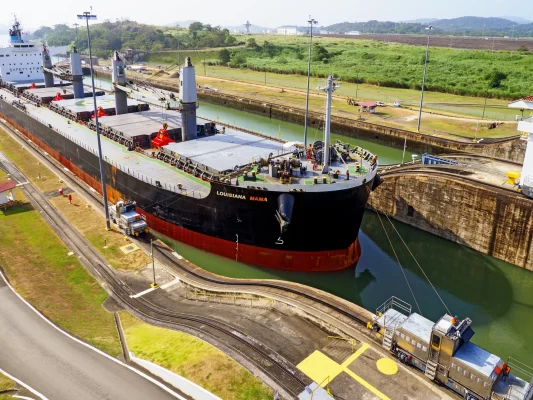
Shipping was not spared either. The Panama Canal, a global artery for global sourcing, which depends on freshwater lake levels to operate, experienced significant disruptions as drought lowered Gatún Lake, triggering transit restrictions, vessel queuing, and higher costs. The knock-on effect for container routing and lead times was felt in supply chains far removed from agriculture. The last major “Super” El Niño event caused billions of dollars in economic losses, including $327 million in the agricultural sector alone.
India’s response imposing export bans to stabilise domestic commodity prices illustrated another dimension of El Niño risk that businesses rarely model: policy risk. When production falls, governments act, and those actions distort the markets that procurement teams in London, Frankfurt, and New York rely on. A well-structured strategic sourcing process anticipates these second-order effects. Many businesses, operating with single-origin supply bases and thin inventory buffers, found in 2023–24 that they did not.
Why 2026–27 El Nino could be different
The 2023–24 event was disruptive. Forecasters tracking the 2026–27 event believe this one could be considerably more so, for reasons that go beyond meteorology alone.
First, the baseline has shifted. Global temperatures are higher than they were a decade ago, meaning an El Niño of equivalent raw intensity now operates on a warmer platform, amplifying its effects. A warming climate does not guarantee that historically temperate regions will experience the cooling conditions they once did during El Niño events, narrowing the buffers that previously offset production losses elsewhere.
Second, the geopolitical context is more complex. Analysis from multiple research institutes notes that the incoming El Niño will likely coincide with conflict-induced trade restrictions that have already strained global fertiliser supply chains, driven transpacific container rates significantly above pre-crisis levels, and disrupted critical urea and phosphorus exports. For businesses operating global sourcing strategies, this is compound risk: a climate shock layered on top of geopolitical fragility.
Third, as the World Economic Forum warned in June 2026, El Niño’s risks now extend beyond agriculture and logistics into technology supply chains and global sourcing strategies. Climate shocks can disrupt power grids, water systems, and data centre operations, threatening the semiconductor production and digital infrastructure on which modern manufacturing depends. This matters to any business sourcing industrial components, electronics, or tech-adjacent products from Asia.
The Expana Markets analysis of the 2026–27 outlook draws the operational conclusion clearly: “For procurement and supply chain leaders, this creates an early opportunity to act. Monitoring El Niño’s evolution now can inform sourcing decisions, stress-test supplier exposure, and help mitigate weather-driven disruptions before they impact costs, availability, and margins.”
The Commodities and Sourcing Markets to Watch
Not all categories face equal exposure. The geographic asymmetry of El Niño creates a mosaic of risk that demands category-by-category analysis exactly the kind of work that sits at the heart of a rigorous strategic sourcing process.
Coffee and cocoa face significant downside risk. Vietnam, the world’s second-largest coffee producer and a critical sourcing market for ET2C clients is among the regions identified as having the highest vulnerability to the developing event, with sea surface temperature anomalies already running above normal. West African cocoa production faces renewed pressure, compounding the supply stress of recent years.
Grains present a more mixed picture. El Niño events have historically improved soybean yields in the United States, Argentina, and Brazil, but Brazil’s government has strong incentives to direct domestic production toward biofuel mandates, potentially limiting export availability regardless of yield outcomes.
Sugar is a category where risk is acute. India and Thailand two of the world’s top five producers are consistently among the most affected by El Niño-induced drought. With carry-over stocks lean in several consuming regions, even a moderate production shortfall translates rapidly into price volatility.
Industrial manufacturing is not immune. Countries dependent on hydropower Brazil, Colombia, parts of Southeast Asia face drought-driven power shortages that increase industrial energy costs and disrupt production schedules. Port infrastructure in Chile, Peru, and Ecuador faces flood risk during El Niño’s wet phase, adding logistics fragility to an already stretched global freight market. For businesses sourcing industrial components or consumer goods from these regions, lead time variability becomes a significant operational risk.
Rethinking Your Strategic Sourcing Process Before the Storm Hits
The macroeconomic fallout from a major El Niño typically peaks four to eight months after initial onset. That lag between the climate signal and the supply chain consequence is the procurement leader’s window of opportunity. It is, to return to Dickens, the spring of hope before the potential winter of despair.
This is precisely where having a structured, intelligence-led approach to strategic sourcing pays dividends. ET2C International, a global sourcing company with over 25 years of experience and on-the-ground teams across China, India, Vietnam, and Turkey, works with clients to build exactly this kind of resilience not as a reaction to crises, but as a standing feature of their sourcing strategy.
A proactive strategic sourcing process in the face of El Niño risk involves several interconnected steps. Geographic diversification is foundational: reducing reliance on single-origin supplier sourcing by identifying climatically distinct alternative sources. A business that sources a critical commodity exclusively from one drought-vulnerable country is not managing risk it is carrying it. ET2C’s multi-market presence, spanning the key manufacturing territories of Asia, is designed specifically to give clients the flexibility to shift sourcing weight between markets as conditions change.
Supplier qualification in alternative markets needs to happen before disruption strikes, not during it. Qualifying a new supplier under pressure with compressed lead times and inflated spot prices is a far worse outcome than maintaining a pre-qualified secondary supply base during stable conditions. ET2C’s on-the-ground factory audit and supplier qualification capabilities across its sourcing markets exist precisely to make this preparation possible.
Buffer stock procurement in high-exposure categories should be evaluated now. The analytical evidence is clear: inflationary pressure peaks four to eight months after El Niño onset. Inventory managers who act in that window rather than reacting to the peak are operating a genuine strategic sourcing advantage.
Contract risk mapping is equally important. Weather-related supply chain interruptions have historically caused businesses to sacrifice contractual prices to secure emergency supply at a loss a cost that forward planning, including robust supplier agreements with clear force majeure and escalation provisions, can reduce materially.
ET2C’s Sourcing Stress Test offers businesses a structured starting point for exactly this analysis — assessing where the vulnerabilities in their current global sourcing strategies lie, before external shocks make those vulnerabilities expensive.
The broader lesson for global sourcing strategies
El Niño does not respect supply chain complexity maps or just-in-time inventory models. It operates on its own timeline, across its own geography, with consequences that cascade through commodity markets, shipping lanes, energy systems, and government policy in ways that are deeply interconnected.
The fishermen who named El Niño did so because the warm current arrived, reliably, around Christmas. For today’s global sourcing teams, the gift is the lead time: the forecasts are early, the signals are clear, and the window to act is open. Effective global sourcing strategies are not built in the eye of the storm they are built in the calm before it.
The question for every procurement and sourcing leader right now is simple: is your supplier sourcing base designed to absorb what is coming, or will it amplify the shock? The storm is coming. The smart money is already moving.
To find out how ET2C International can help stress-test your sourcing strategy ahead of the coming El Niño, visit et2c.com or explore the Sourcing Stress Test.
Frequently Asked Questions

David Young
Position: Group Marketing Director
David W. Young is a recognised thought leader in global sourcing and procurement, sharing expert insights on navigating inflation, managing overheads, and building resilient supply chains. He champions strategic solutions for maximising business value in a volatile world. LinkedIn or david.y@et2c.com.LinkedIn or david.y@et2c.com.