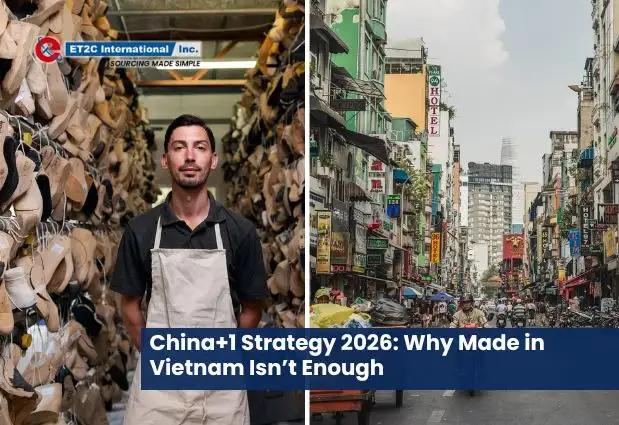
China+1 in 2026: Why “Made in Vietnam” isn’t enough Anymore
ET2C International | Supply Chain & Trade Compliance Blog
China+1 strategy CBP’s Vietnam raids and a 40% transhipment penalty are rewriting China +1. On 28 July 2026, U.S. Customs and Border Protection agents showed up unannounced at Chinese-linked factories across Vietnam. They weren’t there to inspect fire exits.
They pulled production records, checked raw-material sourcing, and poured over value-added ratios to answer one question: had these goods actually been transformed in Vietnam, or just relabelled there? As U.S. Trade Representative Jamieson Greer put it bluntly, the concern is straightforward, “there’s a pure illegal shipment where they send it to Vietnam and put on a Made-in-Vietnam sticker” (Tech Times).
Ten days on, that raid is still the most useful data point any global sourcing & procurement or compliance team could ask for. It confirms something many of us have suspected for a while: the easy version of China+1, pick a new country, ship the same components through it, swap the label is over.
That doesn’t mean diversifying away from China is a bad idea. It remains one of the soundest sourcing strategies available. But it now comes with homework attached and a due diligence requirement, and the companies that skip it are exposed in ways they weren’t two years ago. Risk and Vulnerability needs to be surfaced and understood as part of a wider diversification plan.
Why the raid matters more than it looks for China +1
Failing CBP’s “substantial transformation” test isn’t a slap on the wrist. Goods that don’t clear the bar face a 40% additional duty under HTS 9903.02.01 and crucially, that penalty carries no mitigation or appeal provision. There’s no negotiating your way out once you’re on the wrong side of that line. It’s worth understanding the mechanics here: transshipment enforcement generally treats simple relabelling as outright fraud, while genuine processing say, turning steel slabs into sheet, That distinction is exactly what’s at stake for anyone running production through Vietnam sourcing right now.
or components into a functionally different finished good can legitimately establish new origin (CSIS’s primer on transshipment is a good starting point for where that line sits).
The timing isn’t neutral, either. Vietnam overtook China in early 2026 to become the leading U.S. supplier of laptops and gaming consoles, and its bilateral trade surplus with the U.S. hit record levels in May 2026, exactly the kind of imbalance that draws enforcement attention.
Meanwhile, nine months of U.S.Vietnam trade talks remain stalled, with both sides describing negotiations as “tense and very difficult,” largely because they still can’t agree on how transshipment should even be defined. Vietnam’s electronics sector imports components worth nearly as much as its finished-goods exports, and Chinese-origin inputs are estimated at 5–20% of total product value across segments precisely the ratio customs officials are now scrutinising line by line.
A Global Sourcing issue not just a U.S. problem
It’s tempting to file this under “American tariff policy” and move on. That would be a mistake. Mexico has introduced its own tariffs on non-FTA imports, overwhelmingly China-origin goods, explicitly framed as closing the “back door” into the U.S. market that Mexican assembly had quietly become (ASI Central has the detail, including new duties on cars and auto parts from non-agreement countries). And the EU has applied a comparable “last substantial transformation” standard to non-preferential rules of origin for years the same underlying test, just enforced by a different customs authority, for “Made in” labelling purposes (trade.gov and LKS Attorneys both walk through how the EU applies it in practice). In other words: wherever your “+1” is, someone is now checking whether it’s real. The same logic is playing out across most of the markets we work in. See our full sourcing markets overview for how tariff and compliance exposure compares by country.
Know your risk and vulnerability before customs finds it for you
Here’s the uncomfortable part: most companies can’t actually answer the question CBP is now asking, because they’ve never asked it of themselves. Which SKUs still carry Chinese-origin inputs above the danger threshold? Which suppliers are a single factory inspection away from a 40% duty? Which “+1” country is quietly reproducing the same concentration risk it was meant to solve?
A China+1 move made in 2022 or 2023 for cost or speed reasons was rarely stress-tested against today’s rules, and that gap between assumption and evidence is exactly where enforcement risk now lives. Diversifying for its own sake isn’t enough, either swapping one over-concentrated source for another single country of “+1” just relocates the vulnerability rather than removing it.
Identifying risk and vulnerability in your global sourcing strategy
This is why understanding risk and vulnerability has to come before and not after a change in your sourcing strategy, and why it needs to be more rigorous than a gut-feel review of supplier lists. ET2C’s Sourcing Stress Test is a useful starting point: a free, five-minute diagnostic across five weighted pillars margin leakage, supply risk exposure (concentration and disruption vulnerability across markets), coordination burden, quality and compliance (product, ESG, and regulatory risk across the supplier base), and strategic agility.
The output is a personalised, pillar-by-pillar score that shows where value is leaking and where risk is quietly building, before a customs inquiry, a factory fire, or a failed shipment surfaces it for you.
ET2C International is a British owned global sourcing company with 25 years making sourcing simpler for our clients. Our 250 colleagues are based on the ground in major sourcing markets (China, India, Vietnam and Turkey) to give you deep insight and rapid access to Asian sourcing partners. To talk to one of our colleagues you can conatact us at: contact@et2cint.com

What actually changes for your sourcing strategy
None of this is an argument for staying in China, or for treating sourcing diversification as a lost cause. It’s an argument for doing China+1 properly. The bar has moved from “where is it made” to “can you prove, with documentation, that it was genuinely made there” That’s a factory-floor problem as much as a paperwork one. It’s why we run on-the-ground quality assurance and factory audits for clients making this shift.”
and that proof is now a bigger competitive advantage than the factory’s postcode.
In practice, that means three things converge: quality, compliance, and people who are actually on the ground. Value-added ratios, sourcing records, and production documentation need to be gathered continuously, not reconstructed after a customs inquiry lands. Factory audits need to check technical, social, and environmental compliance as a matter of routine, not a one-off box-tick before an order ships. And someone needs to be physically present in the factory often enough to catch quality fade, sourcing drift, or a supplier quietly reintroducing Chinese inputs before it becomes a customs problem rather than a quality one.
This is exactly the gap between “we moved production” and “our production is defensible under customs law” that the July raids exposed. Tools like ET2C’s China+1 Market Selector can help narrow down where to go next across cost, tariff, and resilience criteria but the harder, ongoing work is factory audits and supplier compliance monitoring paired with in-country quality assurance and quality control that catches problems before a customs officer does.
China+1 is still the right instinct. It’s just no longer a strategy you can execute from a spreadsheet it takes documentation, verification, and people on the ground who can vouch for what’s actually happening in the factory. That’s precisely where ET2C’s sourcing and quality assurance teams work alongside brands day to day.
Frequently Asked Questions

David Young
Position: Group Marketing Director
David W. Young is a recognised thought leader in global sourcing and procurement, sharing expert insights on navigating inflation, managing overheads, and building resilient supply chains. He champions strategic solutions for maximising business value in a volatile world. LinkedIn or david.y@et2c.com.LinkedIn or david.y@et2c.com.