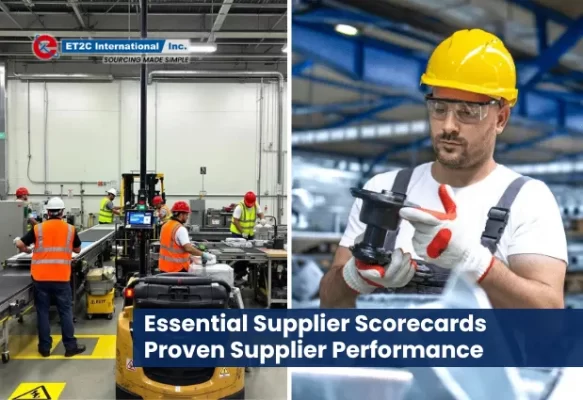
Supplier Scorecards Explained: How Procurement Teams Track Supplier Performance
By ET2C International | Global Sourcing & Supply Chain Intelligence
Do you know which of your suppliers is genuinely performing, and which is simply not failing badly enough to trigger a conversation?
This is the gap that supplier scorecards are designed to close. Most procurement teams have an instinctive sense of which suppliers are strong and which are difficult. Very few have a structured, data-driven mechanism for measuring, communicating, and acting on supplier performance in a way that drives consistent improvement. The result is a sourcing model where relationships are managed by exception, problems addressed reactively, and the commercial value locked inside strong supplier performance management left unrealised.
According to the CIPS Supplier Performance Management guide, organisations with structured supplier performance management frameworks reduce supply chain disruption frequency by up to 35 percent compared to those relying on informal oversight. For businesses sourcing across multiple markets and supplier tiers, the difference between managed and unmanaged supplier performance is the difference between a supply chain that performs and one that requires constant firefighting.
How ET2C International Helps Procurement Teams Get the Data That Matters
For businesses managing global sourcing programmes, the data feeding a supplier scorecard is only as reliable as the oversight that generates it. Remotely managed supplier performance management, where quality scores come from supplier self-reporting and delivery data from the supplier’s own systems, consistently produces results more optimistic than the commercial reality on the factory floor. ET2C International’s in-market teams across China, India, Vietnam, Bangladesh, Turkey, and beyond provide the independent, on-the-ground data collection that makes supplier scorecards genuinely useful. Our quality inspectors, compliance auditors, and sourcing managers generate verified, real-time performance data
defect rates, delivery confirmations, corrective action responses, and compliance findings — that procurement teams need to populate procurement KPIs with confidence. Learn more about our quality assurance and inspection services and how they can strengthen your supplier performance management data foundation. Beyond data collection, ET2C’s strategic sourcing teams support clients in designing supplier scorecard frameworks calibrated to the specific risk profiles of their sourcing markets.
A supplier scorecard template built for a European near-shore supplier requires meaningful adjustment for a multi-tier manufacturing programme in South Asia or Southeast Asia. Our in-market expertise means the procurement KPIs we help clients select and the weighting structures we recommend reflect the actual operating environment, not a generic procurement textbook. To assess your current programme, take ET2C’s Sourcing Stress Test or contact our team directly.
What Are Supplier Scorecards and Why Do They Matter?
A supplier scorecard is a structured evaluation tool that measures a supplier’s performance across a defined set of criteria, typically covering quality, delivery, cost compliance, and responsiveness. The scores give procurement teams an objective, comparable view of how each supplier is performing against required standards and how that performance is trending over time.
The value of a supplier scorecard is not the score itself but what it enables: a shared language between buyer and supplier, a documented basis for performance conversations, and a data foundation for decisions including volume reallocation, contract renewal, and exit. Without it, supplier performance management relies on memory, relationships, and the loudest recent problem rather than evidence.
Research on supplier performance management consistently identifies supplier evaluation as one of the core competencies that distinguish high-performing procurement functions from reactive ones.

The Core Procurement KPIs That Belong on Every Supplier Scorecard
The procurement KPIs that form the basis of a supplier scorecard should reflect the commercial and operational outcomes that matter most to your business. The most effective supplier rating systems are built around a concise set of five to ten KPIs that are measurable, attributable to the supplier, and directly connected to business outcomes.
Quality Performance
Quality is typically the highest-weighted dimension on any supplier scorecard. Core procurement KPIs here include defect rate per shipment, first-time pass rate at incoming inspection, corrective action response time, and defect severity classification across critical, major, and minor categories. The ASQ supplier quality management framework recommends tracking quality KPIs at both shipment and supplier levels over rolling periods to distinguish isolated incidents from systemic patterns that warrant a fundamental relationship review.
On-Time Delivery Performance
Delivery reliability procurement KPIs include on-time delivery rate, lead time consistency against the agreed standard, and advance notice of delays. A vendor scorecard makes delivery patterns visible that informal relationship management consistently obscures. A supplier with a 70 percent on-time delivery rate that has never triggered a formal conversation becomes immediately visible and actionable once scored. The ISM’s research on supplier KPIs and performance tracking notes that delivery and quality metrics, captured systematically through SRM platforms, are the strongest predictors of overall supply chain reliability.
Compliance and Ethical Sourcing
As regulatory obligations tighten under the EU Corporate Sustainability Due Diligence Directive (CSDDD) and the UK Modern Slavery Act, compliance has become a non-negotiable supplier scorecard dimension. Relevant procurement KPIs include social compliance audit scores, certification maintenance, and severity and resolution status of compliance findings. ET2C’s social compliance audit services provide the independent audit data that makes this scorecard dimension reliable rather than self-reported.
Responsiveness and Relationship Quality
Responsiveness procurement KPIs average response time to communications, speed of corrective action implementation, and participation in performance reviews capture what defect rates alone cannot: whether a supplier is a genuine commercial partner or a passive vendor. These metrics are harder to score precisely but are essential for a complete supplier performance management picture.

How to Build a Supplier Scorecard That Gets Used
Most supplier scorecard initiatives fail not because the concept is wrong but because the scorecard is poorly designed, poorly communicated, or disconnected from real procurement decisions. A supplier scorecard template that takes days to populate or produces results that are filed rather than acted on will be abandoned within two reporting cycles. Start by defining what supplier performance management needs to achieve in your specific context.
Select five to ten procurement KPIs measurable from existing data and attributable to the supplier’s own performance. Weight them to reflect commercial priorities. Score quarterly for most suppliers, monthly for high-risk or high-volume relationships. And critically, share results with suppliers. A vendor scorecard that is produced internally and never discussed is a monitoring tool, not a management tool.
Connect scorecard results to commercial decisions. Volume reallocation, contract renewal terms, and exit decisions should all be informed by supplier scorecard data. When suppliers understand that procurement KPIs directly affect the commercial relationship, the scorecard becomes a genuine management lever.
The OECD Due Diligence Guidance for Responsible Business Conduct identifies the link between performance measurement and commercial consequence as the critical factor distinguishing genuine supply chain performance governance from performative reporting.

Three Mistakes That Undermine Supplier Performance Management Measuring Activity Rather Than Outcomes
Building supplier scorecards around activity metric audit visit numbers and report volumes tells you what happened, not whether supplier performance improved. Effective procurement KPIs are outcome-focused: defect rate, on-time delivery percentage, corrective action close-out rate. These measure what the supplier delivered, not what the procurement team did.
Scoring Without Consequence
A supplier scorecard that consistently produces low scores without any commercial consequence will be ignored by suppliers and abandoned by the procurement teams maintaining it. Supplier performance management requires the organisational willingness to act on what the scorecard reveals, including difficult conversations with commercially valuable suppliers. Without that willingness, the supplier rating system is performance theatre.
Ignoring Sub-Tier Suppliers
Most supplier scorecards cover only tier-one suppliers. But supply chain performance risk frequently sits in sub-contracted manufacturers and material suppliers that a buyer never directly engages. A supplier performance management framework that does not address sub-tier visibility is managing the front door of a supply chain, not the full chain. ET2C’s global sourcing teams extend performance monitoring beyond tier-one relationships as part of integrated sourcing programmes.
Frequently Asked Questions: Supplier Scorecards

Anishi Gupta
Position: Digital Marketing Specialist
Anishi Gupta is a Digital Marketing Specialist focused on performance marketing, content strategy, and data-driven growth at ET2C LinkedIn or anishi.g@et2c.com.