EFTA India TEPA in 2026: Key Trade Opportunities and Impact
By ET2C International | Global Sourcing & Trade Intelligence
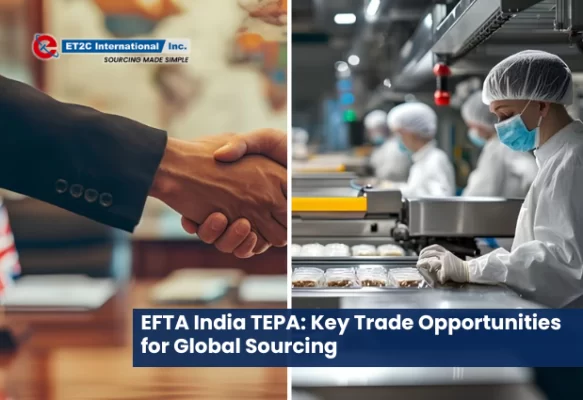
On 10 March 2024, after sixteen years of negotiations and 21 rounds of detailed discussions, India signed one of its most strategically significant trade agreements. The Trade and Economic Partnership Agreement ,TEPA ,between India and the European Free Trade Association (EFTA), comprising Switzerland, Norway, Iceland, and Liechtenstein, marks a defining moment in India’s global trade ambitions and reshapes the landscape for global sourcing from India.
This is not a standard tariff-cutting exercise. The EFTA India TEPA is a strategic alliance built on trust, innovation, long-term investment, and the recognition that India Europe trade has reached a point of mutual commercial maturity. EFTA nations have committed to facilitating USD 100 billion in investment in India over fifteen years. In return, India offers preferential access to one of the world’s largest and fastest-growing consumer markets. For procurement leaders, sourcing directors, and operations teams building global sourcing strategies, the implications are significant and immediate.
At ET2C International, we work with brands across Europe and North America to convert trade policy into operational sourcing results. Our in-market teams across India, China, Vietnam, and Turkey provide the on-the-ground supplier qualification, quality oversight, and compliance infrastructure that turns agreements like EFTA India TEPA from headline news into commercial advantage. As India Europe trade deepens, the businesses that benefit most will not simply be those aware of TEPA ,they will be those with the international sourcing infrastructure to act on it. Explore how ET2C’s global sourcing services for India can support your TEPA readiness.

What the EFTA India Free Trade Agreement Actually Does
The EFTA India free trade agreement, formally the Trade and Economic Partnership Agreement, is designed to reduce tariffs across thousands of goods categories, simplify export procedures for small and medium enterprises, support joint research and technology partnerships, and strengthen supply chain collaboration across sectors including healthcare, clean energy, precision engineering, and financial services. Critically, TEPA complements India’s existing industrial policy frameworks. The Make in India initiative and the Production Linked Incentive (PLI) schemes across fourteen manufacturing sectors are now backed by preferential European market access that makes India export manufacturing significantly more commercially attractive for Western buyers. The EFTA Secretariat’s official TEPA page provides the formal treaty documentation and sector-specific tariff schedules for reference.

Sixteen Years in the Making: Why TEPA Matters Now
When India EFTA negotiations began in 2008, India’s manufacturing landscape looked very different. By the time TEPA was signed in 2024, India had become one of the world’s fastest-growing manufacturing economies. According to the India Brand Equity Foundation (IBEF), India’s merchandise exports have grown from USD 185 billion in 2008 to over USD 430 billion in 2024, reflecting a manufacturing base that has fundamentally transformed in scale, quality, and export orientation. EFTA nations, meanwhile, were actively seeking trusted manufacturing alternatives to China, and found in India a partner offering both scale and democratic market stability.
India–Europe Trade: The Numbers Behind the Partnership
The India Europe trade relationship underpinning TEPA is already substantial. Switzerland alone has contributed over USD 10.8 billion in cumulative investment to India, with more than 340 Swiss companies employing approximately 150,000 professionals across pharmaceuticals, precision engineering, consumer goods, and financial services. India’s exports to Switzerland stand at approximately USD 2.1 billion annually, covering pharmaceuticals, machinery, chemicals, apparel, and leather goods. Norway brings deep interest in India’s renewable energy transition, while Iceland and Liechtenstein contribute specialised expertise in sustainability and financial services respectively. Together, EFTA India bilateral trade is projected to triple within a decade once TEPA is fully implemented, according to analysis by the World Trade Organisation on regional trade agreement outcomes.
What India Gains: Export Access, Investment, and Technology
For India, TEPA delivers three interconnected benefits. First, wider market access for Indian exporters across pharmaceuticals, textiles, engineering components, and IT services sectors that already demonstrate strong India export manufacturing capability. Second, accelerated technology transfer and joint R&D in green energy, medical devices, and advanced manufacturing, areas where EFTA nations have deep expertise that directly strengthens India’s Make in India objectives. Third, investment facilitation that goes beyond FDI numbers to include skills development, sustainability infrastructure, and digital trade capability. The Invest India agency provides updated data on investment inflows across PLI scheme sectors and the specific incentives available to EFTA-based companies establishing or expanding manufacturing operations in India.
What EFTA Nations Gain: A Market That Is Open, Growing, and Tech-Savvy
For EFTA members, India represents something rare in the current global trade environment: a massive, open, growing market with sophisticated domestic demand and a government actively committed to deepening international trade partnerships. EFTA nations gain preferential access to 1.4 billion consumers with rapidly expanding middle-class spending power, strong demand for European precision machinery, medical devices, and chemicals, and a production base that helps companies diversify their supply chain resilience beyond China. The geopolitical dimension is also significant. The OECD’s analysis of trade diversification strategies consistently identifies India as one of the highest-potential markets for Western trade expansion over the coming decade, combining democratic governance, English-language commercial infrastructure, and long-term economic growth that few alternative markets can match.
What TEPA Means for Global Sourcing Strategy
For Western buyers and global brands, the EFTA India free trade agreement reshapes the commercial calculus of strategic sourcing India in three practical ways. Reduced tariffs lower the landed cost of goods manufactured in India and exported to EFTA markets, directly improving the commercial case for India over alternative sourcing destinations. Simplified export compliance reduces the documentation burden on Indian suppliers, making international sourcing programmes from India operationally smoother. And the investment and technology flows enabled by TEPA will accelerate the quality and process maturity of India’s manufacturing base over the next decade.
Supply Chain Resilience and the China+1 Argument
The EFTA India TEPA adds significant weight to the China+1 strategy case for India. Unlike smaller Southeast Asian manufacturing destinations, India offers the sector breadth, engineering talent depth, and long-term scalability to absorb substantial production volumes across multiple categories simultaneously. The McKinsey Global Institute’s research on supply chain resilience identifies supplier base diversification and trade agreement coverage as two of the most reliable structural enablers of supply chain resilience. TEPA directly strengthens both for businesses with India at the centre of their global sourcing strategy.

ESG, Traceability, and the European Compliance Expectation
European buyers operating under the EU Corporate Sustainability Due Diligence Directive (CSDDD) and the UK Modern Slavery Act face mandatory due diligence obligations that extend directly into their global sourcing supply chains. India’s regulatory environment is increasingly aligned with international labour and environmental standards, but compliance verification in a complex, multi-tier India manufacturing landscape requires in-market expertise, not desk-based assessment. ET2C International’s social compliance audit services and quality assurance programmes provide the independent verification that turns TEPA policy benefits into documented, defensible supply chain resilience.
Challenges That Still Need to Be Addressed
The EFTA India TEPA creates a strong framework, but the gap between trade policy and sourcing reality requires deliberate management. Regulatory alignment is the most immediate practical challenge: Indian exporters targeting EFTA markets must meet Europe’s rigorous standards on quality, packaging, labelling, and sustainability, requirements that are non-trivial for suppliers not previously focused on European export compliance. Infrastructure readiness remains a consideration.
India’s logistics costs as a percentage of GDP, currently 13 to 14 percent, exceed global benchmarks of 8 percent, though the National Logistics Policy and PM Gati Shakti Master Plan are both targeted at closing this gap over the next five years. ESG and traceability requirements from European buyers are also intensifying under the EU Green Deal supply chain framework, making supplier transparency a commercial prerequisite for India Europe trade at scale. This is where international sourcing specialists play a critical role. ET2C International’s strategic sourcing services help global brands bridge the gap between TEPA’s policy benefits and factory-floor reality ,from supplier discovery and qualification through quality management, ESG compliance, and logistics coordination.
Frequently Asked Questions: EFTA India TEPA
ET2C International | Global Sourcing, Quality & Compliance

Anishi Gupta
Position: Digital Marketing Specialist
Anishi Gupta is a Digital Marketing Specialist focused on performance marketing, content strategy, and data-driven growth at ET2C LinkedIn or anishi.g@et2c.com.