Should you be considering India for both manufacturing and IT services? If you are not, your competitors probably are.
For most Western businesses, India has occupied two entirely different positions within their global sourcing strategies. The country has long been recognized as the world’s dominant destination for IT outsourcing, software development, and technology services. In manufacturing, however, India has traditionally been treated as an emerging or supplementary option, rarely the first call for a CPO building a primary production network. That distinction is now outdated. And the businesses still operating with a single-function view of India for global sourcing are leaving a material competitive advantage on the table. According to the World Bank, India is now the world’s fifth-largest economy and is projected to become the third-largest by 2030. Its manufacturing exports have grown at a compound annual rate exceeding 10 percent since 2020, while its technology and IT services sector already employs over five million professionals across more than 200 cities. The question is no longer whether India can deliver at scale across both manufacturing and technology. The question is how your business structures its engagement to capture the full value of that capability. This is where strategic sourcing from India, done properly, becomes a genuine competitive differentiator.
Why the India Global Sourcing Question Matters More Than Ever
The structure of global sourcing has fundamentally changed. Western companies are no longer optimising purely for labour arbitrage or the lowest unit cost. Sourcing decisions are now shaped by geopolitical risk, trade disruption, supply chain fragility, ESG obligations, and the need for end-to-end operational visibility. In this environment, the separation between manufacturing hubs and technology hubs is no longer commercially rational. 
The Post-Covid Reckoning for Supply Chain Resilience
The pandemic exposed the structural vulnerability of over-concentrated supply chains. Businesses that had built deep dependencies on single-country, single-supplier models found themselves unable to maintain delivery continuity, production visibility, or cost control when those chains broke. The response has been a sustained and accelerating move toward supply chain resilience: diversified sourcing footprints, multi-country production networks, and China+1 strategy models that reduce single-market exposure. The McKinsey Global Institute’s research on supply chain vulnerabilities estimates that companies typically experience disruptions of one month or longer every 3.7 years, with the most severe disruptions causing losses equivalent to 40 percent of a full year’s profit. The commercial case for supply chain resilience is not about risk management as a theoretical discipline. It is about protecting margin.
Digital Transformation Has Changed What Sourcing Hubs Must Deliver
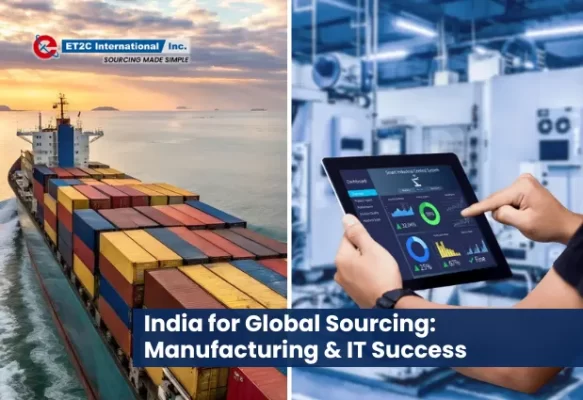
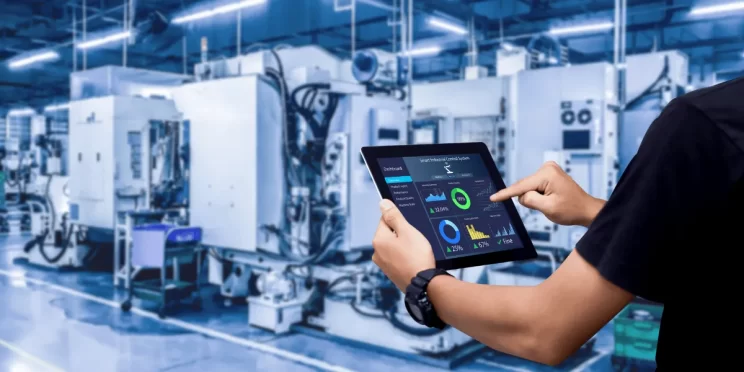
In parallel, digital transformation has accelerated across every sector of industrial and consumer goods production. Modern manufacturing is no longer defined solely by machinery and labour costs. It depends on ERP platforms, manufacturing execution systems, AI-driven quality control, supply chain software, predictive maintenance, and real-time data analytics. Businesses now need sourcing locations that can support physical production and digital execution simultaneously, not sequentially. According to the World Economic Forum’s Future of Jobs Report, technology adoption in manufacturing is accelerating faster than in almost any other sector. The ability to access engineering, software, and production capability within the same ecosystem is no longer a differentiator for the most sophisticated businesses. It is becoming a baseline requirement. This is precisely where India for global sourcing becomes strategically significant. It is one of the very few locations on earth where manufacturing scale and digital depth co-exist at the level required to meet these demands.
India’s Established Strength in IT and Technology Services
India’s role as the world’s dominant destination for IT and technology services is one of the most well-established facts in global business. Over three decades, India has built deep and scalable capabilities across software engineering, cloud computing, enterprise IT services, cybersecurity, data analytics, and artificial intelligence. The National Association of Software and Service Companies (NASSCOM) reports that India’s IT sector generated revenues of over USD 245 billion in 2024, with exports accounting for more than USD 194 billion. The country is home to the world’s largest pool of English-speaking technical talent and has built delivery frameworks that serve the most demanding enterprise clients across North America, Europe, and Australia.
Global Capability Centres and the GCC Model
One of the most significant shifts in sourcing from India over the past decade is the rapid growth of Global Capability Centres, commonly known as GCCs. These are captive offshore operations established by multinational corporations to house product engineering, technology development, data science, and operational support functions within India. According to Deloitte’s India GCC Report, India is now home to over 1,700 GCCs employing more than 1.9 million professionals, with the number expected to reach 2,400 by 2030. Major corporations across financial services, healthcare, retail, logistics, and industrial manufacturing have established GCCs in India not as cost-reduction exercises, but as strategic capability hubs driving innovation, speed-to-market, and technology leadership.
What IT Depth Means for Manufacturing Operations
What is often underestimated in global sourcing strategy is how directly India’s digital depth supports manufacturing operations. Modern factories rely on enterprise systems for production planning, inventory management, regulatory compliance, and logistics coordination. India’s ability to design, implement, and maintain these systems at scale, in the same geographic ecosystem as manufacturing operations, creates a structural advantage that few other sourcing destinations can match. For businesses engaged in strategic sourcing from India, this integration means tighter production control, better supply chain visibility, faster incident response, and a lower total cost of ownership across integrated operations. The technology is not an add-on to the manufacturing. It is embedded within it.
India’s Rapidly Maturing Manufacturing Ecosystem
Parallel to its IT growth, India’s manufacturing ecosystem has undergone a significant and sustained transformation. Historically, Indian manufacturing was largely focused on serving domestic demand, with limited export orientation and inconsistent integration into global sourcing networks. That reality has changed materially over the past decade. Driven by the Indian government’s Make in India initiative, Production Linked Incentive (PLI) schemes across fourteen manufacturing sectors, and increasing participation in global supply chains, India now
supports export-ready manufacturing at scale. The India Brand Equity Foundation (IBEF) reports that India’s manufacturing sector contributes approximately 17 percent of GDP and is targeted to reach 25 percent under the national industrial policy framework.

Key Manufacturing Sectors Where India Delivers at Scale
India today supports high-volume, export-grade production across a wide range of sectors that are directly relevant to Western global sourcing strategies.
Electronics and components is one of India’s fastest-growing export manufacturing sectors, supported by PLI incentives and major investment from Apple, Samsung, and their supply chain partners. India’s electronics exports crossed USD 29 billion in 2024, driven by smartphone assembly, consumer electronics, and industrial components.
Pharmaceuticals and healthcare represent perhaps India’s most globally integrated manufacturing sector. India is the world’s largest supplier of generic medicines, supplying approximately 20 percent of global generic drug exports by volume. The Indian Pharmaceutical Alliance reports that India supplies medicines to over 200 countries, with US FDA and European EMA approvals across hundreds of manufacturing facilities.
Automotive and engineering components have been a traditional strength of Indian manufacturing, with Tier 1 and Tier 2 suppliers serving global OEMs across Europe, the US, and Asia. India’s automotive component industry generated exports of USD 21.2 billion in FY2024, according to the Automotive Component Manufacturers Association (ACMA).
Textiles and apparel remain one of India’s most established global sourcing categories, with world-class manufacturing clusters in Tirupur, Surat, Ludhiana, and Bengaluru producing for leading European and US retail brands. India is the world’s second-largest producer of textiles and the sixth largest exporter of apparel.
Renewable energy equipment, including solar panels, wind components, and energy storage systems, is an emerging and rapidly scaling manufacturing sector in India, supported by the country’s commitment to 500GW of renewable capacity by 2030.
Quality Standards and Export Readiness
A common concern among Western businesses considering manufacturing in India has historically been the consistency of quality standards and compliance frameworks. That concern is increasingly less warranted. Many Indian manufacturing facilities now hold international quality certifications, operate to ISO standards, and have established track records supplying demanding Western markets. The Bureau of Indian Standards (BIS) provides the national quality assurance framework, while sector-specific bodies govern standards across pharmaceuticals, automotive, electronics, and food processing. That said, capability varies significantly between regions, sectors, and individual suppliers. Effective sourcing from India requires in-market knowledge, supplier qualification rigour, and ongoing oversight, not a desk-based assessment of certification credentials. This is where ET2C International’s on-the-ground teams provide direct operational value: our India-based personnel conduct factory assessments, quality audits, and production oversight as part of integrated global sourcing programmes rather than periodic paper exercises.
Where Manufacturing and Technology Converge: India’s Defining Advantage
The most strategically compelling reason to consider India for global sourcing is not its IT capability or its manufacturing scale in isolation. It is the convergence of both within the same ecosystem. This is the structural advantage that separates India from almost every other sourcing destination at scale.
The Factory of the Future Requires Both Disciplines
The factories that will define competitive manufacturing over the next decade are not simply more efficient versions of today’s facilities. They are fundamentally digital operations: networked production floors, AI-driven quality control, predictive maintenance, digital twins, and real-time supply chain integration. Building and operating these environments requires engineering talent that sits at the intersection of manufacturing knowledge and software development, a combination that India’s education system and industrial ecosystem is uniquely positioned to supply. The ILO’s Future of Work in India report highlights India’s position as one of the world’s fastest-growing suppliers of STEM graduates, producing approximately 1.5 million engineering graduates annually. This talent pipeline sits directly at the intersection of the manufacturing and technology disciplines that the factory of the future requires.
Integrated Operations: R&D, Software, and Production in One Ecosystem
Product-based companies are increasingly leveraging India’s dual strengths by placing research and development, software engineering, and manufacturing within the same geographic footprint. This proximity shortens development cycles, improves collaboration between design and production teams, and accelerates time-to-market in ways that geographically separated operations structurally cannot. In global sourcing terms, this integration allows for tighter control over production, better supply chain visibility, and faster response to operational challenges. Businesses that have built integrated manufacturing and technology operations in India report not just cost benefits, but structural improvements in execution speed, product quality, and operational agility that are difficult to replicate through remote management models.
India Within China+1 Strategy: Primary Hub, Not Peripheral Option
The China+1 strategy has become one of the defining themes of global sourcing over the past five years. Driven by tariff exposure, geopolitical uncertainty, pandemic-era supply disruptions, and the strategic imperative to reduce single-market dependency, Western businesses have accelerated the development of manufacturing capacity outside of China. Among the available alternatives, India occupies a uniquely strong position. Unlike some emerging manufacturing destinations that offer scale without digital maturity, or technology hubs that lack industrial production capacity, India increasingly delivers across both dimensions and at a scale that smaller alternative markets cannot match.
India vs Other China+1 Destinations
Vietnam, Bangladesh, Mexico, and Indonesia are all legitimate China+1 strategy destinations for specific product categories and industries. None of them offers the combination of manufacturing depth, technology capability, engineering talent, English-language fluency, and long-term scalability that India provides. The OECD’s analysis of global value chain participation consistently identifies India as one of the highest-potential economies for increasing value chain integration over the coming decade, across both goods production and services delivery. For businesses building supply chain resilience through geographic diversification, India is increasingly being positioned not as a marginal add-on to a China-centric model, but as a primary or secondary hub capable of supporting complex, long-term operations across multiple product categories and business functions.
The Policy Environment Supporting India’s Manufacturing
The Indian government’s industrial policy framework has been deliberately designed to support global sourcing engagement. The Production Linked Incentive (PLI) scheme provides financial incentives across electronics, pharmaceuticals, automotive, food processing, textiles, and eleven other sectors, directly reducing the cost of establishing or scaling manufacturing in India. The Invest India agency, the Indian government’s national investment promotion body, provides structured support for foreign companies establishing manufacturing operations in India, including single-window clearance, regulatory guidance, and sector-specific facilitation. The policy environment has not eliminated complexity, but it has materially improved the ease of engagement for Western sourcing organisations committed to building India into their strategic sourcing models.
How ET2C International Supports Companies Sourcing from India
Recognising India’s potential as a global sourcing destination is one thing. Executing within it is another. India is not a uniform or frictionless market. Capability, quality standards, and operating conditions vary significantly by region, sector, and supplier tier. Companies that approach India for global sourcing expecting a plug-and-play experience consistently underperform relative to those that invest in proper market engagement and in-market oversight. ET2C International has operated in-market teams across India’s primary manufacturing clusters for over 25 years. Our personnel are based in the regions where sourcing decisions are made and production takes place, not managing India relationships remotely from a Western head office. This means our clients benefit from:
Supplier identification and qualification conducted through direct factory visits, not desk-based searches. Our teams assess production capability, quality management systems, workforce standards, and sub-tier relationships as part of structured onboarding programmes.
Quality assurance and production oversight at every stage of the manufacturing cycle. ET2C’s India teams conduct pre-production audits, during-production inspections, and pre-shipment quality checks, with reporting provided within 24 hours of each visit.
Ethical sourcing and social compliance audits aligned to the requirements of Western retail and brand clients. Our teams assess labour standards, working conditions, subcontracting practices, and regulatory compliance as part of integrated global sourcing programmes. Read more about ET2C’s approach to responsible sourcing and social compliance across sourcing markets.
Strategic sourcing advisory for businesses at any stage of their India engagement, from initial market assessment through to established supply base management. Explore ET2C’s strategic sourcing services to understand how our teams support long-term sourcing from India. To speak with our India team or to assess your current global sourcing programme, contact ET2C International directly or take our Sourcing Stress Test to benchmark your sourcing operation across five dimensions, including market coverage, supplier quality, and supply chain resilience.
Challenges Companies Must Navigate When Sourcing from India
Despite the strength of India’s global sourcing proposition, the market is not without its complexities. Understanding them in advance is the difference between a sourcing programme that delivers and one that disappoints.
Regional and Sector Variation
India’s manufacturing capability is not uniformly distributed. Clusters of excellence exist in specific cities and regions: automotive components in Pune and Chennai, textiles in Tirupur and Surat, pharmaceuticals in Hyderabad and Ahmedabad, electronics in Bengaluru and Noida. Approaching India for global sourcing as a monolithic market will produce inconsistent results. Effective strategic sourcing requires understanding which regions and supplier ecosystems are genuinely capable of delivering to your product and quality requirements.
The Execution Gap
The most common failure mode in sourcing from India is not capability. It is execution. Companies that treat India as a remote transactional sourcing relationship, managing supplier relationships from a Western office through email and periodic visits, consistently experience the disconnects that undermine quality, delivery, and margin: specification ambiguity, subcontracting without disclosure, process deviations caught too late, and supplier disputes rooted in unresolved misalignment. The businesses that succeed in India for global sourcing are those that invest in local presence, clear governance frameworks, and long-term partnership relationships. They design operating models that integrate technology with manufacturing goals, and they maintain consistent oversight through in-market teams rather than relying on periodic audits or supplier self-reporting.
Infrastructure and Logistics
India’s logistics infrastructure has improved significantly over the past decade, driven by investment in road, rail, and port capacity. The National Logistics Policy and the PM Gati Shakti National Master Plan are both targeted at reducing India’s logistics cost as a percentage of GDP from the current 13 to 14 percent toward global benchmarks of 8 percent. That trajectory is positive, but logistics cost and complexity remain a consideration in supply chain resilience planning for global sourcing from India, particularly for time-sensitive or high-volume shipment programmes.
Frequently Asked Questions: India for Global Sourcing

Anishi Gupta
Position: Digital Marketing Specialist
Anishi Gupta is a Digital Marketing Specialist focused on performance marketing, content strategy, and data-driven growth at ET2C LinkedIn or anishi.g@et2c.com.