
China Plus 1 Strategy: Why India Is the Decisive Advantage for Global Buyers in 2026
How global sourcing leaders are building resilient, scalable supply chains by adding India as a strategic manufacturing base and what it takes to get it right.
Executive Summary: The China plus 1 strategy has moved from contingency planning to boardroom imperative. Geopolitical tension, tariff volatility, and post-pandemic supply chain exposure have accelerated the search for credible alternatives. India — with its manufacturing depth, engineering talent, government-backed incentives, and expanding export infrastructure — has emerged as the leading China+1 destination for global buyers across electronics, automotive, pharma, textiles, and industrial goods. But success in India is not automatic. It demands local intelligence, structured quality control, and disciplined execution from day one.

What Is the China plus 1 Strategy and Why Is It Accelerating in 2026?
For more than two decades, China dominated global manufacturing. Its infrastructure, supplier density, workforce scale, and logistical efficiency made it the default choice across virtually every product category.
That dominance has not disappeared. But the risk calculus has fundamentally changed.
The China+1 strategy or increasingly China plus 1 sourcing from at least one additional geography alongside China has shifted from a risk-management discussion to an operational reality. Several converging forces are driving this acceleration in 2026:
- Sustained US-China trade tensions and tariff escalations, with Section 301 tariffs on Chinese imports remaining in force and expanding
- The EU Carbon Border Adjustment Mechanism (CBAM) and ESG reporting requirements raising scrutiny on single-origin supply chains
- Continued pandemic-era memory: the systemic shock of over-reliance on one geography has not been forgotten
- Rising Chinese labour costs eroding the cost arbitrage that once made China uniquely compelling
- Geopolitical risk around Taiwan Strait tensions introducing new scenario planning requirements for electronics and semiconductor supply chains
- Customer and investor pressure on supply chain transparency, traceability, and diversification
The result: China+1 and wider supply market diversification is no longer a strategic option. For most multinationals, it is a supply chain requirement. A resilience sourcing strategy, not a cost-cutting exercise. What was called China +1 in reality has expanded to include a rnage of other
sourcing markets. The goal for many is not to abandon China but to add a credible, scalable alternative that reduces single-country dependency without sacrificing quality or continuity.
Why India Has Become the Leading China+1 Destination
India is not new to global manufacturing. What is new in 2026 is the structural readiness, policy maturity, and sectoral depth that India now brings to the global sourcing table.
Government-Backed Manufacturing Scale-Up
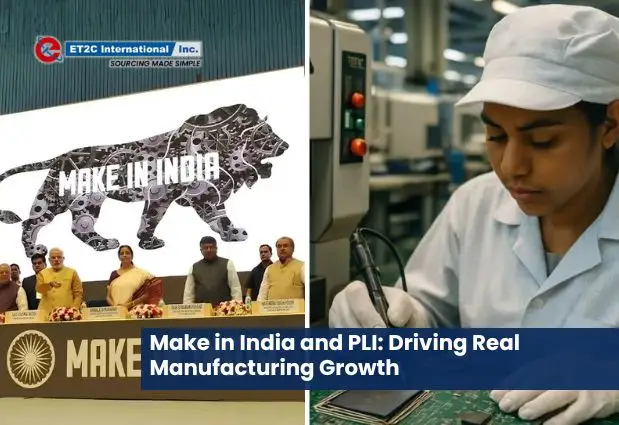
India’s Production-Linked Incentive (PLI) scheme now active across 14 sectors including electronics, pharmaceuticals, textiles, automotive components, and specialty chemicals has committed over USD 24 billion to incentivise domestic manufacturing and exports. This is not policy rhetoric. It is reshaping supplier ecosystems and attracting global capital.
Development and investment of dedicated freight corridor networks are starting to compress logistics timelines and improving port connectivity addressing two of India’s historically cited weaknesses.
A Supplier Ecosystem Coming of Age
India’s manufacturing base has matured significantly. Clusters in Pune, Chennai, Bengaluru, Surat, Ludhiana, and Tiruppur now offer deep vertical integration, process sophistication, and exposure to international compliance standards that were largely absent a decade ago.
Demographic Dividend and Engineering Depth
India produces over 1.5 million engineering graduates annually. Its talent base in process engineering, tooling, quality systems, and technical design is a genuine competitive differentiator. Particularly for categories that require customisation, continuous improvement, and design-to-manufacture capability.
Regulatory Alignment
India’s alignment with international standards bodies including ISO, GMP, REACH, RoHS, and US FDA frameworks is increasingly robust across key export sectors. For global buyers with compliance obligations, this matters.
India’s Strategic Value Beyond Cost Arbitrage
A common mistake global buyers make when evaluating India is anchoring the analysis on labour cost alone. While India does offer competitive input costs, its strategic value in a China+1 model is multidimensional.
| Strategic Value Driver | What It Means for Global Buyers |
|---|---|
| Supply Chain Resilience | Geographic diversification within Asia’s manufacturing ecosystem continuity without disruption |
| Dual-Market Access | India is both a manufacturing hub and one of the world’s fastest-growing consumer markets; sourcing supports both export and domestic strategies |
| Engineering Depth | Strong tooling, process design, and continuous improvement capability critical for customised categories |
| Regulatory Optionality | Reduced exposure to US-China tariff regimes and emerging EU supply chain due diligence regulations |
| ESG Alignment | Growing traceability infrastructure and improving labour standards supporting corporate sustainability commitments |
| Long-Term Scalability | A 1.4 billion-person domestic market and expanding export infrastructure underpin long-term growth potential |
Quality Control: The Non-Negotiable in India Sourcing
For most global buyers, diversification only delivers value if quality is consistent. This is where many early India sourcing programmes fail, not because India lacks manufacturing capability, but because quality control frameworks are not structured correctly from the outset.
Several realities define the quality landscape in India:
- Supplier capability varies widely even within the same industrial cluster, the gap between best-in-class and adequate suppliers is significant
- Documentation discipline and process consistency differ across regions, supplier tiers, and management cultures
- International standards are interpreted and implemented unevenly, certification alone is not a proxy for quality assurance
- Quality problems discovered post-shipment are significantly more expensive to resolve than those caught in-process
This is why quality and compliance frameworks must be embedded from supplier selection, not added as a downstream verification step. Effective India quality control programmes typically include:
- Factory capability audits before onboarding, assessing process maturity, equipment, workforce, and management systems
- Defined quality control plans at product and process level, not generic checklists
- In-process quality checks at critical production stages, not just pre-shipment inspection
- Statistical sampling protocols calibrated to product risk and volume
- Clear non-conformance escalation paths with local accountability
- Supplier performance scorecards reviewed on a structured cadence
Quality & Compliance in India is not a one-time gate. It is an ongoing management discipline. Suppliers that perform well at audit stage can deteriorate under production pressure without active oversight. Continuous monitoring is not optional it is the model.

Why Global Sourcing from India Requires Local Intelligence
India’s manufacturing landscape is diverse, regionally fragmented, and culturally nuanced. It is not a centralised ecosystem, it is a collection of distinct industrial clusters, each with its own supplier behaviours, infrastructure quality, labour dynamics, and compliance culture.
For global buyers, this creates two fundamental execution challenges:
1. Identifying the Right Suppliers
India has a large and growing supplier base, but the gap between ‘available’ and ‘capable and reliable’ is substantial. A supplier that performs well on initial screening or presents impressive credentials may not meet the operational standards global buyers require once production begins at scale. Remote evaluation — based on documents, certifications, and video calls — is not sufficient.
2. Translating Global Expectations into Local Execution
The standards global buyers take for granted — on-time delivery, consistent quality, proactive communication, accurate documentation — cannot be assumed. They must be built into the supplier relationship from day one, through clear specification, structured governance, and active on-ground oversight.
Successful India sourcing programmes share common structural characteristics:
- Deep local market knowledge — understanding regional supplier strengths, cluster dynamics, and infrastructure constraints
- Cultural fluency — effective communication, negotiation, and relationship management aligned with local business culture
- On-ground presence — physical access to production sites for real-time monitoring, not periodic visits
- Structured supplier governance — clear KPIs, escalation procedures, and performance management frameworks
- Early-stage quality embedding — quality systems built into supplier onboarding, not retrofitted after problems emerge
ET2C International Global Sourcing Experts
ET2C are a British owned global sourcing company who have been operating for over 25 years across all major sourcing markets. Our 250 colleagues are based on the ground in all major sourcing markets to ensure our clients have easy access and deep insight into sourcing markets.
Our team based in Delhi have been working with our clients to deliver the benefits of building India into global sourcing strategies. Our teams work with the clients to deliver:
- Margin build
- Risk management
- Supplier search and validation
- Quality & compliance management
To talk to our colleagues about the advantages of sourcing from India contact@et2cint.com
Where China plus 1 Strategies Fail and Why
Many global companies significantly underestimate the execution gap between strategic intent and operational reality when entering India as part of a strategic sourcing plan. The most common failure modes are predictable and avoidable with the right planning :
| Failure Mode | Why It Happens |
|---|---|
| Rushed supplier onboarding | Pressure to show progress drives shortcuts in due diligence and capability assessment |
| Assuming quality will self-align | Buyers assume international standards are universally understood and applied when they are not |
| Over-reliance on documentation | Certifications and audit reports are treated as proof of performance rather than starting points for verification |
| No continuous quality monitoring | Pre-shipment inspection replaces active in-process quality control so problems are discovered too late |
| Lack of local accountability | Remote management of India suppliers without on-ground representation creates a critical oversight gap |
| Treating India as a vendor swap | China+1 requires system redesign process, quality, governance, and communication structures all need reconfiguration |
India and China: A Complementary Model, Not a Replacement
The most resilient global sourcing strategies emerging in 2026 are not binary. They are not choosing between China and India they are building India + China strategies where each geography contributes according to its strengths.
China continues to lead in:
- Ultra-high-volume, high-speed manufacturing at scale
- Deep supplier specialisation and sub-component ecosystems
- Rapid prototyping and short development cycles
- Complex electronics and advanced component manufacturing
India excels in:
- Supplier diversification and geopolitical risk reduction
- Engineering-led manufacturing and technical customisation
- Cost-quality balance across mid-complexity categories
- Pharmaceutical, specialty chemical, and life sciences supply
- Long-term scalability backed by domestic market growth
China plus 1 works best when India is integrated with strategic intent with the right product categories, the right suppliers, and the right execution framework not rushed into as a reactive hedge.
How ET2C Supports Global Buyers in china plus 1 Execution
ET2C works with global buyers, international sourcing teams, and multinational manufacturers who want to engage with India strategically, not experimentally.
Rather than operating as a transactional intermediary, ET2C functions as an on-ground sourcing and risk-management partner: providing the local intelligence, quality infrastructure, and execution discipline that China+1 programmes require to succeed.
ET2C’s Five-Stage China pluse 1 Support Model
- Supplier Discovery and Validation Identifying suppliers aligned with specific sector, scale, compliance, and capability requirements not just cost
- Quality Check and Audit Frameworks Structured factory audits, in-process quality control, and ongoing quality assurance calibrated to product category and buyer standards
- Execution Oversight On-ground teams monitoring production timelines, quality deviations, and supplier performance in real time
- Risk Mitigation Early identification of cultural, regulatory, operational, and quality risks, before they become shipment problems
- Long-Term Supplier Development Converting vendor relationships into reliable, scalable supply partnerships with measurable performance improvement over time
What Global Buyers Should Assess Before Committing to India
Before formalising India as a sourcing base, decision-makers should work through a structured evaluation:
- Which product categories genuinely fit India’s current capability — not aspirational capability?
- What quality control infrastructure is required, and can it be built from day one?
- Is there on-ground visibility, or will the programme be managed remotely?
- How will supplier performance be measured, and who owns escalation?
- What is the realistic timeline to stable, scalable production — and is there executive patience for it?
- Which local partners bring genuine market knowledge, not just introductions?
The bottom line: India rewards preparation and penalises assumptions. Companies that succeed in India approach it as a system design challenge, not a vendor substitution exercise.
Explore India as Part of Your china plus 1 Strategy
ET2C specialises in partnering with global buyers, sourcing teams, and international manufacturers building reliable, compliant, and scalable supply chains in India. Whether you are evaluating India for the first time or seeking to accelerate an existing programme, we offer a structured engagement process grounded in on-ground intelligence and operational discipline. Connect with our team at contact@et2cint.com to begin a strategic conversation.

David Young
Position: Group Marketing Director
David W. Young is a recognised thought leader in global sourcing and procurement, sharing expert insights on navigating inflation, managing overheads, and building resilient supply chains. He champions strategic solutions for maximising business value in a volatile world. LinkedIn or david.y@et2c.com.LinkedIn or david.y@et2c.com.