Strategic sourcing: how to build long-term business value through global procurement
In today’s volatile global economy, strategic sourcing has become one of the most powerful levers businesses can pull to improve margins, reduce supply chain risk, and create lasting competitive advantage. Yet too many companies still treat procurement as a transactional, price-led exercise, missing the deeper value that a disciplined, intelligence-driven approach to global sourcing can unlock. Whether you are a mid-size retailer managing a complex product range or a multinational manufacturer with suppliers across multiple continents, the difference between reactive buying and true strategic procurement can define your bottom line.
According to Deloitte’s 2024 Global Chief Procurement Officer Survey, 79% of CPOs cite cost reduction as a top priority, but only 37% say their procurement function is seen as a strategic partner by the wider business. Closing that gap is precisely what a structured approach to strategic sourcing is designed to achieve.

ET2C INTERNATIONAL GLOBAL SOURCING EXPERTS
ET2C International is a British-owned global sourcing company with 25+ years of experience helping businesses simplify, optimise, and execute their sourcing strategies. With 250 colleagues on the ground across China, India, Vietnam, and Turkey, ET2C delivers rapid, trusted access to the right sourcing partners, combining deep market intelligence, rigorous supplier selection, and end-to-end sourcing execution to turn sourcing strategy into measurable commercial results. To test your sourcing strategy for risk and opportunity, contact one of our team members at contact@et2cint.com or take the Sourcing Stress Test.

1. Strategic sourcing is a business decision, not a buying task
What does strategic sourcing actually mean?
Strategic sourcing is a structured, long-term procurement approach that evaluates suppliers on total value, including quality, reliability, risk, compliance, and innovation, rather than price alone. It aligns purchasing decisions with business strategy to deliver margin improvement, supply continuity, and competitive advantage.
The most important shift any procurement leader can make is recognising that strategic sourcing is not simply about finding the cheapest supplier. It is a long-term, value-led business decision that connects procurement directly to your company’s growth strategy, operational resilience, and competitive positioning. According to the Chartered Institute of Procurement & Supply (CIPS), strategic sourcing involves the systematic evaluation of supply options to deliver total value, not just unit cost savings.
How strategic sourcing connects to business performance
When businesses move beyond price-led purchasing and adopt a strategic procurement approach, they gain the ability to align their supply chain decisions with wider business goals, including margin improvement, supply continuity, brand reputation, and long-term supplier relationships. Research by McKinsey & Company consistently shows that companies with mature strategic sourcing capabilities outperform peers on cost savings, supply chain agility, and supplier-led innovation, achieving 2 to 3 times greater savings than average peers and 40% more likely to report strong supplier innovation pipelines. The message is clear: procurement leadership is a boardroom issue, not just a back-office function.
ET2C International positions itself precisely at this intersection, helping clients move beyond reactive purchasing into a structured, insight-driven model that delivers procurement as a genuine competitive advantage.
- Align sourcing decisions with business strategy and long-term growth goals
- Move from unit-price thinking to total cost of ownership and value creation
- Build supplier relationships that support innovation, quality, and scalability
- Improve gross margins through category-led procurement optimisation
Real-world example: dual-market sourcing in practice
A UK homeware retailer working with ET2C shifted from single-source procurement in China to a dual-market model across China and India. The result was a 12% reduction in total landed cost, a three-week improvement in average lead times, and a second qualified supplier was activated within 90 days of programme start, providing immediate resilience against port disruption.
2. Global sourcing requires market intelligence and disciplined analysis
What is supply market intelligence, and why does it matter?
Supply market intelligence is the systematic gathering and analysis of data about suppliers, cost drivers, capacity, quality standards, geopolitical risks, and regulatory requirements in target sourcing markets. It enables procurement teams to make informed, data-led sourcing decisions rather than relying on price comparisons alone.
Effective global sourcing begins long before a Request for Proposal is issued. It starts with a thorough understanding of the supply market: the landscape of available suppliers, prevailing cost structures, capacity constraints, quality benchmarks, and the geopolitical or regulatory risks that may affect supply continuity. Without this foundation of market intelligence, sourcing decisions are based on guesswork rather than data, and that is where costly mistakes are made.
How ET2C builds market intelligence on the ground
ET2C’s on-the-ground presence in China, India, Vietnam, and Turkey gives clients an intelligence advantage that is very difficult to replicate remotely. Local teams understand not just who the suppliers are, but how they operate, including their financial stability, workforce practices, quality management systems, and capacity for growth. This depth of supplier intelligence transforms procurement strategy from theoretical to actionable.
The sourcing landscape has shifted materially since 2022. US-China trade tensions and tariff uncertainty have accelerated China plus one sourcing strategies, with Vietnam and India absorbing significant volume in apparel, electronics, and components. Turkey has emerged as a nearshoring option for European buyers seeking shorter lead times. ET2C’s four-market presence directly addresses this diversification trend.
A disciplined strategic sourcing process incorporates spend analysis, category forecasting, total cost modelling, and supplier market mapping. The Institute for Supply Management (ISM) highlights that leading procurement teams invest heavily in analytics and forecasting capabilities to anticipate supply market shifts before they become operational crises. Businesses that partner with ET2C benefit from these capabilities without needing to build expensive internal teams from scratch.
Learn more about how ET2C approaches global sourcing services across its key markets.
- Comprehensive supplier market mapping across target sourcing geographies
- Total cost of ownership modelling, including logistics, duties, and lead times
- Category-specific demand forecasting and spend consolidation analysis
- Geopolitical and trade compliance risk assessment by region
- Benchmarking of quality standards against category best practices
- Currency risk modelling and landed cost sensitivity analysis
- Tariff classification review and duty optimisation across sourcing geographies
3. Supplier selection should be rigorous, transparent, and multi-criteria
Why supplier selection is the highest-leverage procurement decision
Best-practice supplier evaluation uses a multi-criteria scorecard that balances cost competitiveness, quality management systems, delivery reliability, financial stability, regulatory and ESG compliance, and innovation capacity. A weighted scorecard approach ensures the decision is data-led and aligned with long-term business outcomes, not just upfront price.
If there is one message that every business pursuing strategic sourcing should internalise, it is this: supplier selection is not a commodity activity. Choosing the wrong supplier, even one that appears cost-competitive on paper, can generate hidden costs through quality failures, delivery delays, compliance breaches, and reputational damage that far exceed any upfront savings. A rigorous, transparent, and multi-criteria supplier evaluation process is non-negotiable for businesses serious about procurement excellence.
ET2C deploys a structured scorecard methodology that evaluates potential sourcing partners across multiple weighted dimensions. This approach, endorsed by frameworks such as the Gartner Supply Chain Top 25 methodology, ensures that supplier selection decisions are defensible, data-driven, and genuinely optimised for business outcomes.
The 7-factor supplier scorecard
- Quality: certifications, audit history, defect rates, and corrective action responsiveness
- Cost: total landed cost modelling including duties, freight, and currency risk
- Delivery: lead time reliability, capacity flexibility, and logistics infrastructure
- Compliance: regulatory adherence, ethical trade standards, and environmental certifications
- Financial stability: credit assessments, ownership structure, and long-term viability
- ESG performance: carbon footprint, labour standards, and community impact
- Innovation: R&D investment, design capability, and willingness to co-develop
Step-by-step supplier evaluation process
- Define category requirements and weightings. Establish the relative importance of cost, quality, delivery, and ESG for your specific category before shortlisting begins.
- Conduct supplier landscape mapping. Identify all viable suppliers in target markets using ET2C’s on-the-ground intelligence network.
- Issue a structured RFI. Request standardised information covering financial health, certifications, capacity, and ESG credentials from all shortlisted suppliers.
- Score against the weighted scorecard. Apply the 7-factor evaluation matrix to produce objective, comparable supplier scores.
- Factory audit and site visit. ET2C conducts in-person audits at shortlisted supplier facilities, validating quality systems, labour practices, and capacity claims.
- Commercial negotiation. ET2C’s local market knowledge enables cost benchmarking and commercially informed negotiation, typically achieving 5 to 15% improvement on initial supplier pricing.
- Onboard and monitor. Structured onboarding with KPIs from day one, followed by ongoing performance tracking. See ET2C’s supplier management services for more details.
4. Risk management and supply chain resilience are part of value creation
What are the biggest supply chain risks in 2025?
The supply chain risk environment in 2025 is defined by four converging pressures: US tariff escalation and the threat of further Section 301 tariffs on Chinese goods; Red Sea shipping disruptions adding 10 to 14 days to Asia-Europe transit times and increasing freight costs by 150 to 300%; ESG compliance obligations tightening under the EU Corporate Sustainability Due Diligence Directive (CSDDD); and increasing climate-related supply disruptions. Businesses without diversified sourcing programmes are materially exposed on all four fronts.
The disruptions of recent years, from pandemic-related factory closures and the global supply chain shocks documented by UNCTAD to geopolitical tensions affecting trade routes, have elevated supply chain resilience to the top of every CEO’s agenda. For businesses relying on global sourcing, the question is no longer whether disruption will occur, but how well-prepared their supply chain is to absorb it.
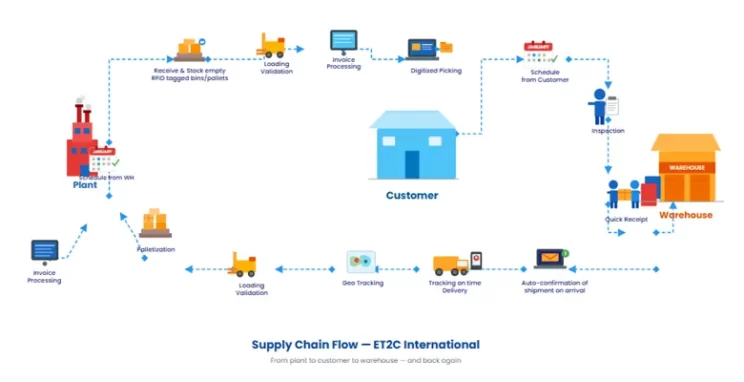
How to build supply chain resilience through strategic sourcing
ET2C integrates risk management into every stage of the strategic sourcing process, not as an afterthought, but as a core value driver. This includes identifying single-source dependencies, assessing supplier financial fragility, mapping geographic concentration risks, and building contingency supplier programmes that can be activated quickly if the primary supply is disrupted. With 25+ years of navigating supply disruptions across China, India, Vietnam, and Turkey, ET2C can identify hidden exposures faster than any team working without on-the-ground intelligence.
- Geopolitical and trade policy risks, including tariff changes and export restrictions
- Supplier operational risks, including labour disputes, energy costs, and capacity constraints
- Quality and compliance risks through factory auditing and certification verification
- Currency and commodity price volatility affecting total landed cost
- Regulatory and ESG compliance risk in key import markets
- Shipping and logistics disruption, including port congestion and freight rate volatility
- Climate and weather-related supply disruption in manufacturing regions
- EU CSDDD and UK Modern Slavery Act compliance across supplier tiers
Nearshoring use case: Turkey as a resilience strategy for European buyers
A European fashion brand exposed to rising Asia-Europe freight costs and extended lead times engaged ET2C to develop a Turkey nearshoring programme alongside its existing China supply base. Within six months, 30% of core products were dual-sourced, average lead times fell from 14 weeks to 6 weeks for Turkey-made lines, and the brand achieved full CSDDD Tier 1 compliance across all active suppliers.
To rapidly test your sourcing strategy for vulnerability and opportunity, contact ET2C’s team for a sourcing risk assessment.
5. Execution matters as much as strategy
Why most sourcing strategies fail at the implementation stage
One of the most common failures in procurement transformation is the gap between strategic intent and operational reality. Many businesses invest in developing a sourcing strategy only to find that execution falters in RFx management, negotiation, onboarding, and ongoing supplier performance management. Strategy without execution is simply a document.

ET2C’s 6-stage sourcing implementation process
ET2C is built around implementation, not just advice. Its on-the-ground teams in key sourcing markets support clients across the entire sourcing lifecycle, from initial category scoping and supplier identification through structured RFx processes, commercial negotiation, factory onboarding, quality inspection, and ongoing performance monitoring. This end-to-end capability gives ET2C clients a decisive advantage as a strategic sourcing partner that understands both the commercial logic and the operational realities of global procurement.
- Strategy. Define category scope, savings targets, quality standards, and risk parameters. ET2C runs a rapid sourcing strategy assessment to identify where the greatest commercial opportunity and risk exposure exists.
- Intelligence. ET2C’s in-country teams map the supplier landscape, gather cost intelligence, and produce a market briefing covering the top 10 to 20 qualified suppliers in the category.
- RFx. Structured RFI and RFP issued to shortlisted suppliers, with responses evaluated against the weighted scorecard. Typically, 3 to 5 suppliers advance to the factory audit stage.
- Negotiation. ET2C’s teams negotiate on the ground using live market cost benchmarks, typically achieving 5 to 15% improvement on initial supplier pricing.
- Onboarding. New supplier onboarded with quality control protocols, compliance documentation, and KPI framework in place from the first order.
- Monitor. Ongoing supplier performance monitoring against agreed KPIs, with quarterly business reviews and corrective action processes for any deviations.
- Sourcing strategy development aligned to business growth objectives
- Market intelligence gathering and supplier landscape mapping
- Structured RFx and shortlisting against multi-criteria scorecards
- Commercial negotiation supported by deep market cost knowledge
- Supplier onboarding, quality systems verification, and compliance checks
- Ongoing supplier performance monitoring and relationship management

Anishi Gupta
Position: Digital Marketing Specialist
Anishi Gupta is a Digital Marketing Specialist focused on performance marketing, content strategy, and data-driven growth at ET2C LinkedIn or anishi.g@et2c.com.