Large-Scale Manufacturing : Can It Serve Western Markets?
For Western markets, the question is no longer whether India can manufacture but whether India can manufacture at scale, with consistency, and to global standards.
As global supply chains undergo structural change, procurement leaders, sourcing heads, and operations teams across the UK, Europe, and North America are reassessing where large-scale manufacturing should sit in the next decade. Rising geopolitical risk, escalating cost pressures, labour volatility, and over-dependence on single-country sourcing models have forced a rethink.
Within this context, India has moved from being a future option to a serious manufacturing contender. But large-scale manufacturing for Western markets demands more than capacity. It requires volume reliability, quality consistency, export readiness, regulatory compliance, and logistics resilience, all delivered repeatedly, not occasionally.
So, can India truly handle Large-scale manufacturing in India for Western markets? The answer is yes with the right conditions, sectors, and execution models in place.
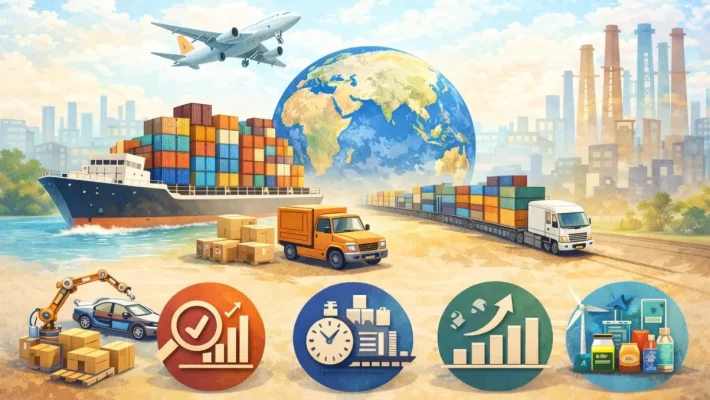
What Does “Large-Scale Manufacturing” Mean for Western Markets?
Before assessing India’s readiness, it’s important to define what Large-scale manufacturing in India actually means from a Western buyer’s perspective.
Large-scale manufacturing typically involves:
- High-volume production runs across multiple SKUs
- Consistent quality output over long production cycles
- Ability to meet tight delivery schedules and global lead times
- Compliance with Western regulatory frameworks
- Scalable capacity to support growth, seasonality, and demand spikes
- Robust supply chain integration, from raw materials to last-mile export
For Western markets, this often applies to industries such as:
- Electronics and electrical equipment
- Automotive components and assemblies
- Pharmaceuticals and medical manufacturing
- Industrial and engineered goods
- Textiles, apparel, and home products
- Renewable energy equipment
- Consumer goods and FMCG manufacturing
Large-scale manufacturing is not just about producing more; it is about producing predictably, compliantly, and at speed.
Why Western Buyers Are Reassessing India Now – Large-scale manufacturing in India
India’s growing relevance is closely tied to global supply chain realignment. Over the last decade, Western manufacturers have faced:
- Supply chain disruptions
- Trade restrictions and tariffs
- Rising labour and operating costs
- Geopolitical uncertainty
- Increased pressure for ethical sourcing and supply chain transparency
These challenges have accelerated the adoption of China+1 and multi-country sourcing strategies, where buyers seek complementary manufacturing bases rather than full replacement.
India fits this requirement well due to:
- Manufacturing scale
- A large, skilled workforce
- Improving infrastructure and logistics
- A strong domestic supplier ecosystem
- Government-backed focus on export-oriented manufacturing
For Western markets, India now represents a balance between scale, cost efficiency, and long-term resilience.
India’s Manufacturing Scale: Capacity Is No Longer the Constraint
One of the most persistent myths about India has been its ability to manufacture at scale.
In reality, India already operates at a significant scale across multiple sectors:
- Millions of units per month in electronics assembly
- Global leadership in pharmaceutical production
- High-volume automotive component manufacturing
- Large-scale textile and apparel exports
- Expanding capacity in industrial machinery and engineering
India’s advantage lies not in a single mega-factory model, but in cluster-based manufacturing ecosystems, regions where suppliers, labour, logistics, and ancillary services are concentrated.
This decentralised scale allows:
- Faster capacity ramp-up
- Supplier redundancy
- Risk distribution across regions
- Multi-vendor sourcing within the same geography
For Western buyers, this provides scalable volume without single-point failure risk.
Export-Focused Manufacturing Is Now the Standard, Not the Exception
A decade ago, many Indian manufacturers were focused primarily on domestic demand. Today, this has changed fundamentally.
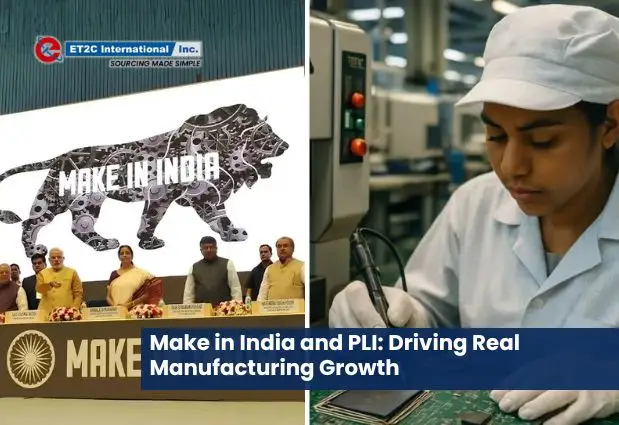
Driven by the Make in India initiative, manufacturers are increasingly:
- Designed for export markets
- Certified to international standards
- Integrated into global supply chains
- Familiar with Western compliance norms
Factories now invest heavily in:
- ISO, CE, FDA, and other global certifications
- Quality management systems
- Traceability and documentation
- Export logistics and customs readiness
For Western markets, this shift reduces onboarding friction. Conversations with Indian suppliers are no longer introductory; they are commercial, technical, and strategic.
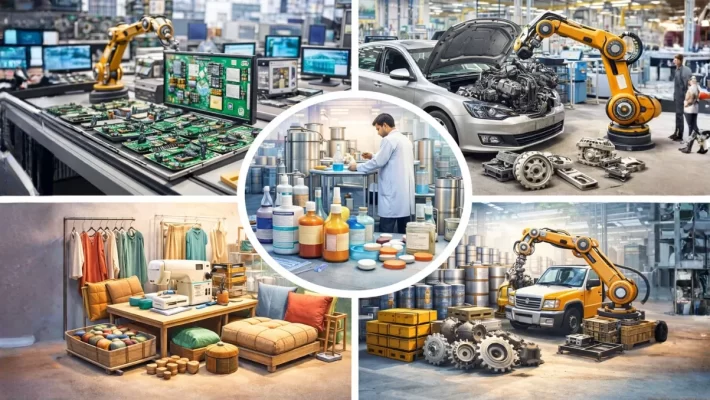
Which Sectors in India Can Truly Support Large-Scale Western Demand?
Not all sectors scale equally. India’s strength lies in specific industries where volume, process maturity, and export experience intersect.
Electronics and Electrical Manufacturing
India has rapidly expanded its electronics manufacturing capacity, particularly in:
- Consumer electronics
- Electrical components
- Assembly and sub-assembly operations
Large production volumes, improving yield rates, and global OEM partnerships have positioned India as a scalable electronics base.
Automotive Components
India is already embedded in global automotive supply chains, producing:
- Engine components
- Transmission parts
- Precision-machined assemblies
The sector demonstrates strong process discipline, quality consistency, and export reliability. Pharmaceuticals and Healthcare Manufacturing India is one of the world’s largest producers of: Large-scale manufacturing in India
- Active pharmaceutical ingredients (APIs)
- Generic medicines
- Medical consumables
Regulatory familiarity with Western agencies makes this sector particularly export-ready. Textiles, Apparel, and Home Products India supports large-volume textile production with: Large-scale manufacturing in India
- Integrated supply chains
- Skilled labour pools
- Seasonal scaling capability
This makes it attractive for Western retailers seeking both volume and variety.
Industrial and Engineered Goods
India’s engineering base supports:
- Heavy machinery components
- Industrial assemblies
- Capital goods manufacturing
This sector is increasingly relevant for B2B Western buyers.
Quality Consistency: The Real Test of Scale
For Western markets, quality at scale is non-negotiable. India’s challenge historically was variation between suppliers not inability. That gap is narrowing rapidly.
Today:
- Tier-1 manufacturers operate at global quality benchmarks
- Tier-2 suppliers are improving through process standardisation
- Quality governance frameworks are increasingly common
Buyers who invest in:
- Supplier audits
- Quality control systems
- On-ground monitoring
consistently achieve outcomes comparable to other mature manufacturing hubs.
Logistics, Infrastructure, and Delivery Reliability
Large-scale manufacturing is meaningless without reliable logistics. India has made measurable progress in:
- Port capacity expansion
- Dedicated freight corridors
- Digital customs clearance
- Export logistics optimisation
While regional inconsistencies remain, major manufacturing corridors now support:
- Predictable export timelines
- High container throughput
- Multi-modal logistics access
Western buyers sourcing at scale typically mitigate variability through:
- Buffer inventory strategies
- Multi-port routing
- Regional supplier diversification
The Role of Governance and Execution Discipline Large-scale manufacturing in India
India rewards structured engagement. Western buyers who succeed at scale:
- Define clear specifications
- Establish governance frameworks
- Maintain ongoing supplier oversight
- Invest in relationship continuity
Those expecting plug-and-play sourcing often struggle.
Large-scale manufacturing in India works best when buyers treat sourcing as a strategic function, not a transactional one.
Why On-Ground Presence Still Matters – Large-scale manufacturing in India
One of the biggest differentiators in successful large-scale sourcing is local execution capability.
India operates on:
- Context
- Relationships
- Real-time problem solving
Buyers with:
- Local teams
- Trusted sourcing partners
- Regional quality oversight
consistently outperform those managing remotely.
This is why many Western firms rely on local sourcing partners to bridge global expectations with local realities. Large-scale manufacturing in India
How India Compares to Other Manufacturing Hubs
India is not replacing China; it is complementing it. Compared to other alternatives:
- Offers greater scale than Vietnam or Thailand
- Provides stronger engineering depth than emerging hubs
- Delivers better long-term capacity growth
Within China+1 strategies, India is increasingly the primary secondary hub, not a marginal add-on.
Final Perspective: Can India Handle Large-Scale Manufacturing for Western Markets?
Yes, when approached strategically.
India today can support large-scale manufacturing for Western markets across multiple industries. It offers volume capacity, improving quality consistency, expanding export readiness, and growing logistics capability.
The differentiator is not India’s potential; it is execution discipline. Western buyers who invest in:
- Preparation
- Governance
- Local expertise
- Long-term partnerships
are already manufacturing at scale in India successfully. India is no longer the question. How buyers engage with India is. ET2C is best suited for global buyers, international manufacturers, and sourcing teams that want to enter or expand in India with strong quality control, local accountability, and long-term sourcing discipline.

Anishi Gupta
Position: Digital Marketing Specialist
Anishi Gupta is a Digital Marketing Specialist focused on performance marketing, content strategy, and data-driven growth at ET2C LinkedIn or anishi.g@et2c.com.